Google Ads has long been considered the most powerful advertising platform in digital marketing, yet many affiliates have historically avoided it due to compliance challenges and account suspensions.
Affiliates have traditionally struggled to harness their power, often preferring Meta, TikTok, and native networks due to their less restrictive policies and easier setup processes.
This trend is changing dramatically in 2025 and 2026. At the last affiliate conference in Bangkok, multiple experts discussed the significant shift occurring as more affiliate marketers successfully integrate Google Ads into their traffic portfolio. These insights reveal how the landscape is evolving for affiliate marketing on Google’s platform.
Summary:
- The Gold Mine
- Master Google Ads
- Compliance Foundation
- Matching Products to the Right Google Format
- The Ad Tutorial Breakthrough
- Tracking like a Pro
- Your Google Affiliate Action Plan
- How to Scale Google As An Affiliate
- The CPV Lab Advantage for Google Ads
The Untapped Gold Mine
Google remains the most sophisticated advertising platform ever created, with second place so far behind “it’s not even relevant to talk about it,” as Yancy Naughton, founder of HasTraffic, recently noted at a Bangkok affiliate conference.
Yet Google Ads has typically been viewed as hostile territory for affiliates. The labyrinth of policies, frequent account suspensions, and lack of dedicated support made many marketers stick with Facebook, TikTok, and native ad networks instead.
That landscape is changing rapidly. Google has formed specialized teams specifically for the affiliate industry, and successful marketers are developing new strategies that work within Google’s ecosystem rather than fighting against it.
Why Now Is the Time to Master Google Ads
There are several compelling reasons why now is proving to be a breakthrough period for affiliates on Google.
- ✅ Tap into specialized support teams – Google now has internal teams focused on helping affiliates succeed.
- ✅ Leverage Demand Gen – A powerful push traffic format across YouTube and Gmail.
- ✅ Focus on educational content – Ad Tutorials are converting better than direct product pages.
- ✅ Use proper tracking – Without it, you’re flying blind (hint: CPV Lab handles this beautifully).
Arian Ghotbi explained that this YouTube-focused ad format is bridging the gap between Google and impulse-buying channels: “What it’s trying to do is it’s trying to challenge the monopoly that Meta has on push traffic.
Let’s dive into how marketers are finally cracking the code.
The Compliance Foundation: What Top Google Affiliates Do Differently
Ashish Gaba, founder of Worify a Dubai-based marketing agency that successfully runs Google, Meta, and native ads, highlighted three critical compliance elements that keep his accounts running smoothly:
- Meticulous policy research: Instead of skimming policies, successful affiliates thoroughly study the detailed guidelines for their specific verticals.
- Proper landing page structure: Including clear affiliate disclosures, privacy policies, and refund terms.
- Truthful marketing claims: Focusing on quality user experience rather than deceptive practices.
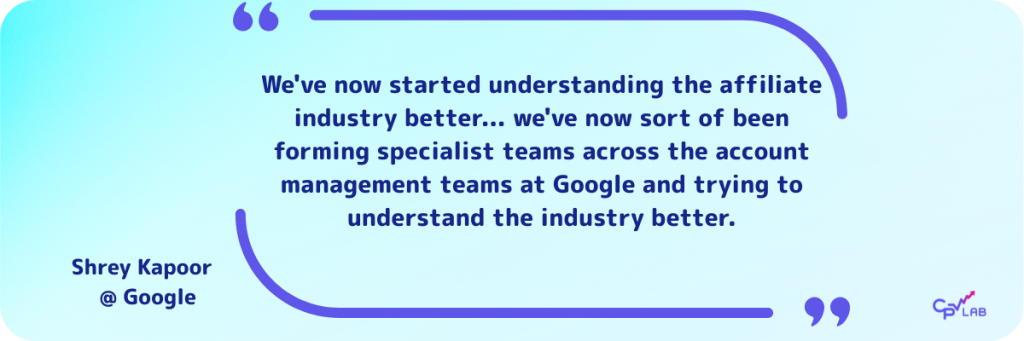
Arian from Cyrus Digital added that Google’s detailed policy documentation makes troubleshooting much easier than on Meta: “Where Meta is a proper black box, you get banned with no explanation, Google’s policy is super detailed. If your account gets suspended, look for the specific policy that relates to your product, make sure you’re in line, contact support with evidence of compliance, and you’ll often get reinstated.“
During a panel in Bangkok, Google’s representative Shrey emphasized that policy compliance isn’t just about avoiding suspensions, it’s about establishing credibility as a genuine advertiser. She emphasized several critical compliance elements that successful affiliates implement to maintain active accounts. These best practices are particularly important for advertisers in regulated industries like nutraceuticals:
- Avoid medical claims that violate healthcare advertising policies
- Include clear affiliate disclosures on landing pages
- Implement comprehensive refund and privacy policies
- Ensure business information consistency across accounts
As Ashish noted during the panel, “It’s better to read policies. I know it’s boring yet but it’s better than waking up and seeing your ad account is suspended and all your traffic is gone.“
These compliance strategies have allowed many affiliates to successfully maintain campaigns in restrictive verticals while scaling to significant daily spend levels.
Quick Compliance Checklist:
- ✅ Thoroughly read Google’s vertical-specific policies
- ✅ Include affiliate disclosures, privacy & refund policies
- ✅ Avoid exaggerated health or financial claims
- ✅ Ensure consistency across domains, accounts, and payment info
Traffic Channel Mapping: Matching Products to the Right Google Format
One of the biggest mistakes affiliates make is trying to force products into the wrong ad format. The panel experts emphasized understanding which Google products work best for different verticals:
For High-Intent Products (Users Already Searching)
Google Search remains powerful for products where people are actively seeking solutions. However, competition has made CPCs expensive in many niches.
The breakthrough strategy here is Ad Tutorials – longer-form educational content addressing specific user questions. Instead of targeting highly competitive terms like “best neck pain pillow,” successful affiliates target problem-awareness queries like “I’m a 40-year-old man with neck pain, what should I do?“
Ashish noted these campaigns typically achieve
- 3-5% conversion rates
- Significantly lower CPCs than standard search
- Above-average landing page quality scores
For Impulse Purchase Products
This is where Demand Gen is revolutionizing Google for affiliates. This format allows advertisers to reach users across Google properties with visually engaging ads, similar to Meta’s approach.
Arian from Cyrus Digital emphasized: “Over 50% of winning creatives on Meta actually crush on Demand Gen. It’s as easy as taking your top-performing Meta creatives, converting them to Demand Gen format, and running the ad. In most cases, you’ll see about a 20% revenue increase because it’s that powerful.”
The Ad Tutorial Breakthrough: Google’s Affiliate Secret Weapon
| Product Type | Best Google Format | Reason |
| High-Intent | Search + Ad Tutorials | Lower CPC, Higher Quality Score |
| Impulse | Demand Gen | Visual, push-style, fast conversions |
| Regulated | Ad Tutorials + Performance Max | Policy-safe entry points |
The most exciting development in affiliate Google marketing is the rise of Ad Tutorials. These are essentially educational articles that address specific user problems while naturally recommending products.
Why Ad Tutorials Work
- Higher-funnel targeting: They capture users earlier in the buying journey, when competition is lower.
- Lower CPCs: They typically cost 30-50% less than highly competitive commercial terms.
- Higher quality scores: Google rewards educational content that genuinely helps users.
- Long-term stability: Once you find a winning Ad Tutorial, it tends to perform consistently for months.
Two Winning Ad Tutorial Formulas
The Ranking List
The classic approach is creating “best of” style content.
For example, “5 Best Solutions for Chronic Back Pain” that evaluates different products.
The Personal Story
Ashish revealed that their highest-converting approach is the personal narrative: “Storytelling, like someone’s personal journey with a product, works really well for us. It’s basically UGC (user-generated content) in text form.“
These personal stories typically achieve:
- 5-8% conversion rates
- Above-average landing page scores
- Lower CPCs due to high relevance
Tracking: The Secret Weapon of Google Success
Every panelist emphasized proper tracking as the foundation of Google’s success. CPV Tracker is a powerful tool specifically designed for affiliates.
Why CPV Lab Is Becoming Essential for Google Affiliates
CPV Lab and CPV One provides several critical advantages for Google campaigns:
- Cross-channel attribution: Track performance across Google, Meta, TikTok and other sources in a unified dashboard.
- Conversion API integration: Push conversion data back to Google for better algorithm optimization.
- Landing page multivariable testing: Test multiple variants without creating separate pages.
- Bot traffic filtering: Eliminate invalid traffic that could trigger Google’s quality systems.
- Unlimited campaigns and events: Scale without hitting tracking limitations.
The platform’s self-hosted nature also gives affiliates more control over their data and helps with compliance by properly implementing privacy policies and user consent mechanisms.
But if you don’t like the technical part, you can opt for CPV One, cloud hosted tracker.
Real-World Google Ad Team Structure
Building a successful Google affiliate operation requires specific roles. Arian shared that Cyrus Digital’s most effective structure consists of:
- Account Strategist: “Take someone very, very senior, put them in a strategy position… This guy’s only in charge to tell you okay. This is how you’re going to get this account from A to B.”
- Media Buyer: “Someone who’s really, really strong, you know, typically we use a professional with like three to five years’ experience, and that is the person executing.“
- Technical Specialist: “You don’t want to have your media buyer trying to fix tracking, right? You need someone who understands who’s more technical, feed optimization, and all these things.“
According to Arian, “For me, a good Google team and a good Google account always consist of top-to-top-to-stratagies, a really strong media buyer and a very precise technical expert, and that’s how we run it.”
At CPV Lab we offer the top technical experts to help you setup your Google Ads tracking. You, as a media buyer, come with your campaign expertise. This is the best combination for great campaigns!
While Ashish mentioned that AI tools are making individual operations more feasible (“With AI now even a single affiliate can do really well”), the specialized team structure provides the expertise balance needed for large-scale operations.
Getting Started: Your Google Affiliate Action Plan
If you’re ready to break into Google traffic, here’s a simplified roadmap:
- Study relevant policies for your vertical before creating accounts
- Set up proper tracking with a solution like CPV Lab or CPV One
- Start with Demand Gen if you’re coming from Meta/TikTok, or Ad Tutorials if you have a high-intent product
- Focus on landing page quality with proper disclosures and policies
- Build a team with strategic, tactical, and technical expertise
How to Scale Google As An Affiliate: Lessons From $8-Figure Campaigns
According to Shrey Google representative, when 100 advertisers start, typically 30-40 scale successfully, a much better ratio than most affiliate traffic sources.
Top performers shared these scaling principles:
- Start with policy first: Build campaigns around Google’s guidelines rather than trying to fit non-compliant offers into the platform.
- Maintain consistency across business entities: Ensure your payment entity matches your advertiser verification and landing page information.
- Leverage AI for faster testing: Use Google’s AI bidding and targeting to test more offers quickly instead of manual optimization.
- Focus on user experience: High-quality landing pages not only avoid suspensions but also lower CPCs through better quality scores.
- Diversify within Google’s ecosystem: Successful affiliates often run search, Demand Gen, and Performance Max simultaneously, creating a diversified but manageable traffic portfolio.
The CPV Lab Advantage
For serious affiliates tackling Google, proper tracking infrastructure is non-negotiable. CPV Lab offers several advantages that make it particularly well-suited for Google campaigns:
- Self-hosted or cloud-hosted tracking: choose the one that is better for you
- Multi-user access: Perfect for team-based management
- API integrations: Pass conversions back to Google for better optimization
- Unlimited campaigns: Scale without restrictions
- Multivariate testing: Test landing page elements without creating separate pages
- Detailed statistics: Track performance across multiple dimensions
The Future of Affiliate Marketing on Google
Google’s AI-driven innovations are creating new opportunities for affiliates.
As Ashish noted, “With AI now, even a single affiliate can do really well. We’re an AI-first agency, we’ve connected AI with Google’s Ads API so I can just ask a question and get all the data I need or post a campaign with a simple prompt.”
This AI integration is lowering the barrier to entry while simultaneously raising the ceiling for scale. Affiliates who master this combination of compliance, proper tracking, and AI-enhanced campaign management are seeing unprecedented success.
CPV tracker latest version comes with many AI functionalities, including an AI Copilot to help optimizing campaigns.
Your technical expert is here.
Are you ready to start running Google Ads campaigns and become a PRO?