AI isn’t coming for your job as a media buyer, but media buyers who use AI will outperform those who don’t. The marketers seeing the biggest gains aren’t using AI to replace their thinking. They’re using it to accelerate research, eliminate repetitive tasks, and test ideas faster than ever before.
This guide covers 12 practical ways to use ChatGPT, Claude, and Gemini for campaign optimization, based on how successful performance marketers are actually using these tools today.
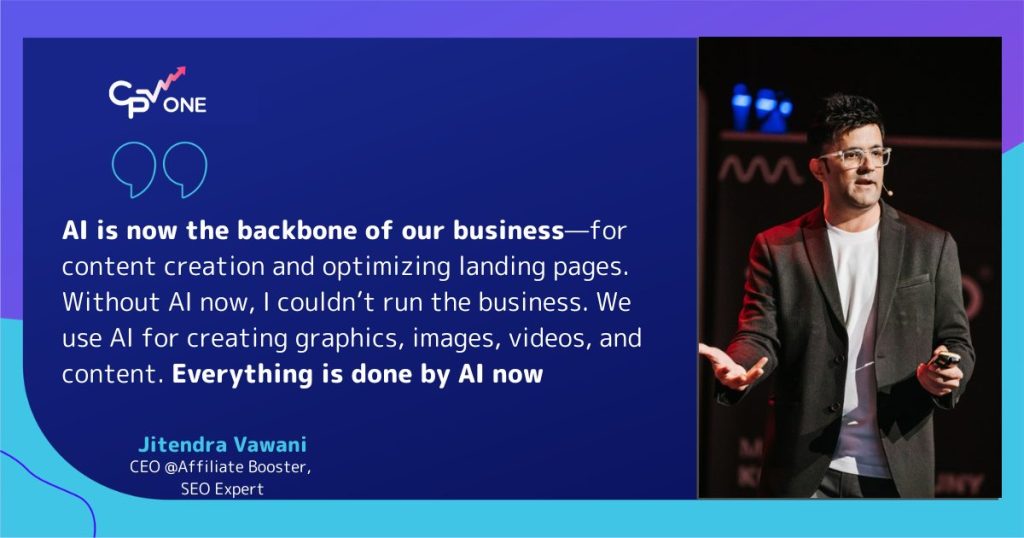
“AI is now the backbone of our business, for content creation and optimizing landing pages. Without AI now, I couldn’t run the business. We use AI for creating graphics, images, videos, and content. Everything is done by AI now.”
— Jitendra Vaswani, The Future of Affiliate Marketing: Insights from SEO Expert Jitendra Vaswani
Quick Comparison: ChatGPT vs Claude vs Gemini
Before diving into specific use cases, here’s when to use each tool:
| Task | ChatGPT | Claude | Gemini |
| Ad copy writing | Best | Great | Good |
| Long document analysis | Good | Best | Good |
| Current statistics | Limited | Limited | Best |
| Data/spreadsheet work | Best | Great | Good |
| Image generation | DALL-E built in | No | Imagen built in |
| Coding/scripts | Best | Great | Good |
1. Rewrite Product Descriptions That Actually Sell
Most e-commerce sites have product descriptions that describe rather than sell.
The difference between “This supplement contains Vitamin D” and compelling copy that addresses the customer’s actual problem is often the difference between a 1% and 3% conversion rate.
Evan Weber, who’s been optimizing digital campaigns for over 20 years, uses this approach with his e-commerce clients: upload all product descriptions to ChatGPT in a spreadsheet, then have it rewrite them to focus on benefits rather than features.
The results speak for themselves, clients see measurable increases in conversion rates simply from better copy.
Example prompt:
“Rewrite this product description to focus on customer benefits rather than features. Address the problem the customer is trying to solve. Use an emotional, benefit-driven tone. Keep it under 150 words. Target audience: [describe your customer]. Current description: [paste description]”
2. Generate Ad Headline Variations at Scale
Testing is the foundation of successful media buying, and headlines are often the highest-leverage element to test.
Instead of manually brainstorming 20 headline variations, use AI to generate them in minutes.
The key is giving the AI enough context about your offer, audience, and what’s already working. Don’t just ask for “headlines”: provide your best-performing headline, explain why you think it works, and ask for variations that test different angles.
Once you have your variations, use a tool like MV Lab to test multiple headline variations on your landing pages and automatically track which combinations win.
Example prompt:
“My best-performing headline for this weight loss supplement is ‘The 30-Second Morning Ritual That Melts Stubborn Belly Fat.’ It works because it’s specific (30 seconds), implies ease (morning ritual), and targets a specific problem (stubborn belly fat). Generate 15 headline variations that test: different time frames, different body parts, curiosity hooks, and fear-based angles. Keep each under 10 words.”
3. Analyze Competitor Ads and Landing Pages
Before creating anything, smart media buyers research what’s already working.
You can use spy tools like Adplexity to find winning campaigns, then use AI to accelerate your analysis by extracting patterns from competitor landing pages.
Copy a competitor’s landing page text and paste it into Claude (which handles long documents better than other tools). Ask it to identify the persuasion techniques being used, the objections being addressed, the emotional triggers, and the structure of the argument. This gives you a framework to work from rather than starting from scratch.
Example prompt:
“You are a direct response copywriter analyzing a competitor’s landing page. Identify: (1) The main emotional triggers being used, (2) How objections are being addressed, (3) The structure of the persuasion argument, (4) Specific phrases that create urgency, (5) How social proof is incorporated. Then suggest 3 angles they’re NOT using that I could test: [paste landing page text]”
4. Get Current Industry Statistics (Use Gemini)
One limitation of ChatGPT and Claude is that their training data has a cutoff date. For current statistics, Gemini has an advantage because it can access Google’s search index.
Evan Weber uses a smart workflow: ask Gemini or Google’s AI tools for current statistics on your industry, then take those statistics to ChatGPT to write content using them. This combines Gemini’s access to current data with ChatGPT’s superior writing quality.
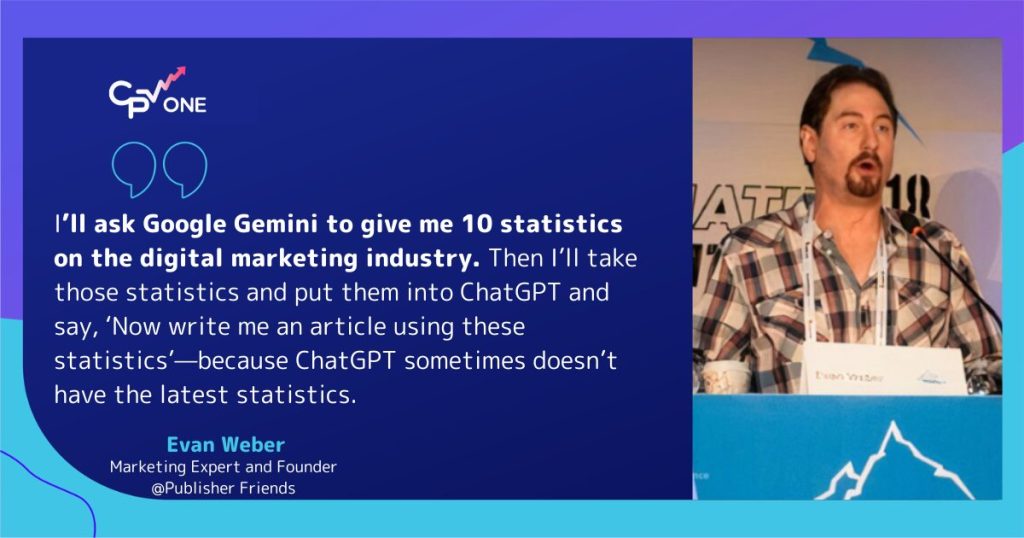
“I’ll ask Google Gemini to give me 10 statistics on the digital marketing industry. Then I’ll take those statistics and put them into ChatGPT and say, ‘Now write me an article using these statistics’, because ChatGPT sometimes doesn’t have the latest statistics.”
— Evan Weber, Evan Weber: How to Use LinkedIn and Google Ads for B2B and Affiliate Marketing Success
5. Create UGC Video Scripts
User-generated content (UGC) style videos consistently outperform polished brand content on Meta and TikTok. AI can help you create scripts faster, but the key is giving it the right framework.
For TikTok especially, the first five seconds determine whether anyone watches the rest.
Experienced media buyers have proven time and again that the hook is everything, some have found that simply testing different opening hooks on the same body content can dramatically change results, sometimes scaling a video from zero traction to hundreds of leads.
Focus your AI prompting on generating multiple hook variations rather than complete scripts.
Example prompt:
“Write 10 different 5-second hook openings for a UGC-style video promoting [your product]. The hooks should feel like someone naturally talking to camera, not scripted. Test these angles: personal story (‘I never thought this would work…’), shocking statistic, direct question to viewer, problem agitation, and transformation reveal. Each hook must create an open loop that makes the viewer need to keep watching.”
For actual video production, tools (like these here) can take your script and generate the entire video with AI avatars, useful for testing concepts quickly before investing in real UGC creators.
6. Summarize Long VSLs and Webinars
Analyzing what makes successful VSLs (Video Sales Letters) work requires watching hours of content. AI can compress this process dramatically.
Download the transcript of a successful VSL (YouTube’s auto-generated subtitles work fine), then upload it to Claude, which handles long documents best.
Ask it to identify the structure, key persuasion moments, objection handling, and the emotional arc. You’ll learn in 10 minutes what would take an hour of watching.
Example prompt:
“Analyze this VSL transcript as a direct response marketing expert. Create a structural outline showing: (1) How the hook grabs attention in the first 60 seconds, (2) Where and how the problem is agitated, (3) How the solution is introduced and positioned, (4) Where objections are handled and what techniques are used, (5) How urgency is created before the CTA, (6) The specific call to action and offer stack. Also identify the 5 most persuasive techniques used that I could adapt for my own campaigns: [paste transcript]”
7. Process Campaign Data and Find Patterns
ChatGPT with Code Interpreter (now called Advanced Data Analysis) can process your campaign data directly. Export your campaign performance as a CSV, upload it, and ask specific questions about patterns in your data.
This is particularly useful for finding non-obvious correlations: which ad creative elements appear in your top performers, what time of day converts best, which audience segments have the highest LTV, or how performance varies by placement.
If you use CPV Lab or CPV One for tracking, you can export detailed campaign reports and feed them directly into ChatGPT for analysis. For even faster insights, use CPV Copilot, CPV Lab’s built-in AI assistant, select your campaign and then you ask questions about your campaign data in plain English (or any other language) and get specific, actionable answers in seconds, without exporting anything. CPV Copilot is linked to OpenAI ChatGPT and the campaign data is analyzed directly without your export and prompting.
Example prompt:
“Analyze this campaign data CSV. Find: (1) Which ad sets have the best ROAS and what they have in common, (2) Any correlation between time of day and conversion rate, (3) Which placements are underperforming relative to spend, (4) Recommendations for budget reallocation based on the data. Flag any statistical outliers. Create visualizations where helpful.”
8. Generate Email Sequences
Email remains one of the highest-ROI channels for affiliate marketers, but writing effective sequences takes time. AI can draft sequences that you then refine with your voice and specific offer details.
The key is providing context about the subscriber’s journey:
- how they opted in,
- what they’re expecting,
- what objections they likely have,
- what action you want them to take.
Generic email templates don’t convert, personalized sequences do.
“It’s all about data. At the end of the day, it’s about what actually converts, not what we think should convert. Tracking makes that clear.”
— Jonathan Bouchard, The Art of Affiliate Marketing: An Interview with Jonathan Bouchard
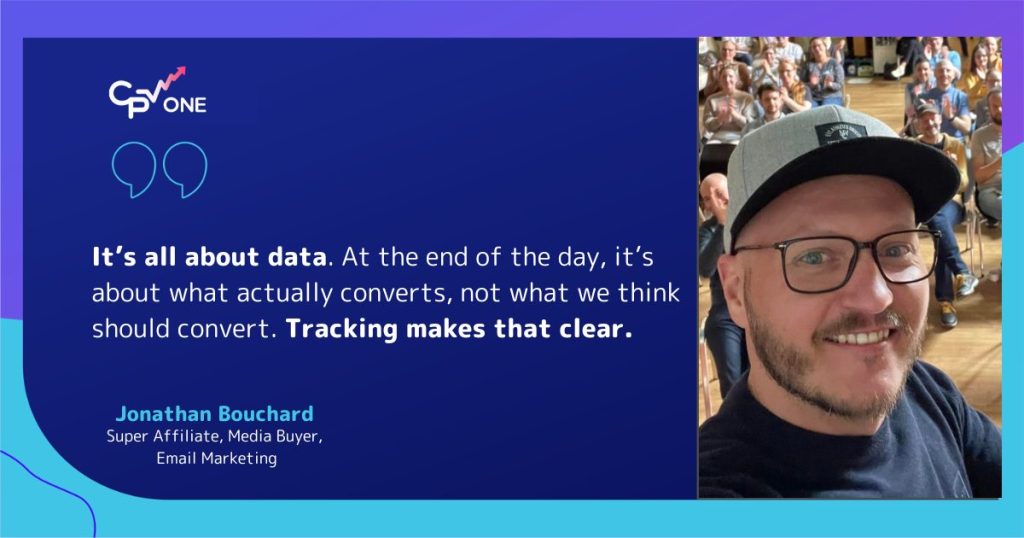
Jonathan Bouchard, who built his affiliate business on email marketing, split-tests different offers in every email rotation and lets the data decide which VSL or landing page gets the traffic.
AI can accelerate this process by generating multiple email variations to test, from subject lines to story angles to CTAs.
Example prompt:
“Create a 5-email welcome sequence for subscribers who opted in via a ‘Free Guide to Better Sleep’ lead magnet. The goal is to sell a $47 sleep supplement. Each email should use a story-based approach (not a hard sell). Email 1: deliver the guide and build curiosity. Email 2: share a relatable success story. Email 3: address the objection ‘supplements don’t work for me.’ Email 4: create urgency with a limited offer. Email 5: final call with a stronger CTA. Keep each email under 200 words. The sender name is [your name], make it feel personal, not corporate.”
9. Identify Landing Page Improvements
Your landing page’s conversion rate has a multiplier effect on your entire campaign. A page that converts at 2% instead of 1% effectively doubles your budget. AI can help identify optimization opportunities you might miss.
Jitendra Vaswani treats ChatGPT like an always-available optimization partner, asking it to improve content, identify missing elements, and suggest layout changes. As he puts it, it’s a resource that’s available 24 hours a day and never gets tired.
Once AI identifies improvements, use multivariate testing (MV Lab Tool inside CPV Lab and CPV One) to test those changes against your control and let data decide the winner.
Example prompt:
“You are a conversion rate optimization expert reviewing an affiliate landing page. The offer is [describe offer] targeting [describe audience]. Review this copy and identify: (1) Where visitors are most likely to drop off and why, (2) Missing trust elements that high-converting pages typically include, (3) How the headline could be stronger and more specific, (4) Whether the CTA is clear, compelling, and visible, (5) How social proof could be better utilized. Provide specific rewrite suggestions, not just general advice: [paste landing page text]”
10. Research Audience Pain Points
Understanding your audience’s real problems, in their own words, is the foundation of effective ad copy. AI can help you research and synthesize this faster.
One effective approach: paste Amazon reviews for competing products, Reddit discussions about the problem you’re solving, or forum posts from your target audience. Ask AI to identify the most common complaints, the language people use to describe their problems, and emotional triggers that appear repeatedly.
This kind of research is also invaluable for building listicle-style landing pages that address specific pain points.
Example prompt:
“Analyze these Amazon reviews for sleep supplements. Identify: (1) The top 5 complaints people have, using their exact phrases, (2) What language they use to describe the problem (not the product), (3) Patterns in what satisfied vs disappointed reviewers say, (4) Objections or skepticisms that appear 3+ times, (5) Emotional language that signals strong pain points I could use in ad copy. Organize by frequency so I can prioritize the most common angles: [paste reviews]”
11. Create A/B Test Variations
Effective A/B testing requires isolating single variables. AI can help you create controlled variations that test specific elements without changing everything at once.
Give AI your control version and specify exactly what you want to test:
- a different emotional angle, a different opening hook,
- a different CTA,
- a different structure.
This ensures you’re testing hypotheses rather than randomly changing things. CPV Lab’s MV Lab AI Assistant takes this a step further, it suggests element variations based on your vertical, snippet type, and the examples you’ve already entered, so you’re not starting from a blank page every time you need something new to test.
Example prompt:
“Here’s my control landing page headline and subheadline. Create 3 variations, each testing ONE specific variable while keeping everything else identical: (1) Variation A: change the emotional angle from benefit-based to fear-based, (2) Variation B: rewrite as a question format instead of a statement, (3) Variation C: add a specific number or statistic to make the claim more concrete. Explain what hypothesis each variation tests so I know what to look for in results: [paste headline and subheadline]”
12. Build Custom GPTs for Repetitive Tasks
If you find yourself giving AI the same instructions repeatedly, create a custom GPT (in ChatGPT) or Project (in Claude) with your standard context pre-loaded.
For example, you could create a custom GPT that knows your brand voice, your typical customer profile, your compliance requirements, and your offer details. Then every time you need ad copy, you don’t have to re-explain the context, just describe what you need.
This is particularly valuable for teams. Instead of each team member figuring out how to prompt effectively, you create one optimized workflow that everyone can use consistently.
What NOT to Do with AI
AI accelerates your work, it doesn’t replace your expertise.
Here are the common mistakes to avoid:
Don’t publish AI content without editing. AI writing often has telltale patterns that experienced readers recognize. Always add your voice, specific examples, and real data.
Don’t trust AI for facts. AI can hallucinate statistics, misremember dates, and confidently state things that aren’t true. Verify anything factual before publishing.
Don’t use generic prompts. “Write me ad copy” gives you generic results. The more context, constraints, and examples you provide, the better the output.
Don’t skip the testing. AI-generated copy still needs to be tested against your control. Sometimes the human-written version wins. Let data decide, not assumptions about AI capabilities.
Bonus: AI That’s Already Built Into Your Tracker
ChatGPT, Claude, and Gemini are powerful for content creation and research, but when it comes to campaign optimization, you still need to export data, paste it, prompt correctly, and interpret the output. That’s where purpose-built AI inside your tracking platform saves real time.
With CPV Lab Version 13, we built four AI features directly into the tracker, each one designed to solve a specific problem media buyers told us was slowing them down:
CPV Copilot (Beta): An in-product AI assistant that analyzes your campaign data and answers questions in plain English (or any language, via text or voice). Instead of spending 30–45 minutes building custom reports and cross-referencing stats, you select a campaign and ask: “Which landing pages should I pause?” or “Is this campaign ready to scale?” Copilot analyzes the data and gives you specific, actionable answers in seconds. It doesn’t make decisions for you, it does the data analysis grunt work so you can make decisions faster.
AI Smart Rotations: Automatic traffic optimization that adjusts how your campaign traffic is split between landing pages and offers based on real performance. After a configurable number of visitors, the system measures conversions, revenue, and ROI, then updates each page’s traffic share so you send more visitors to the best-performing options, without manual work.
You don’t need to log in and tweak percentages three times a day. The key advantage: it eliminates lag time. Even if you check campaigns twice daily, you’re spending hours sending traffic to underperforming pages before you notice. Smart Rotations catches it immediately. Losing pages still remain in rotation but receive less traffic until you decide otherwise.
AI Page Validation: Runs automatic checks when you save a campaign so you know everything is correct before you go live. It catches broken links, missing tracking code, incorrect offer formats, and click-ID problems, and even runs a VirusTotal scan on your landing pages to reduce the chance of ad network rejections. Each failed check comes with a clear message and suggested fix, so you launch with confidence instead of discovering errors after spending money on bad data.
MV Lab AI Assistant + Saved Variations: MV Lab got two upgrades lately.
First, you can now save and edit your page variations, making it easy to regenerate code from an existing variation without starting over.
Second, the AI Assistant inside MV Lab suggests better variations for your landing page elements, headlines, CTAs, and copy, based on your vertical, snippet type (button, headline, content, etc.), and the first 3 variations you enter as examples.
Click the magic wand icon, and the Assistant generates one new variation. You can use it, generate a new one, or change the tone. It generates up to 3 variations total, and they’re added automatically with traffic shares.
Here’s what that looks like in practice:
| Problem | AI Feature | What It Does | Time Saved |
| Data analysis takes too long | CPV Copilot | Answers campaign questions in plain English | 30–45 min → seconds |
| Manual optimization is exhausting | AI Smart Rotations | Auto-shifts traffic to winners | Runs 24/7, no manual checks |
| Setup mistakes waste budget | AI Page Validation | Catches errors + runs VirusTotal scan before launch | Prevents wasted spend + rejections |
| Don’t know what to test next | MV Lab AI Assistant | Suggests variations by vertical + snippet type | 1 hour → 10 minutes |
These features work together as a complete AI workflow: Validation ensures error-free setup, MV Lab AI generates test variations, Smart Rotations auto-optimizes traffic, and Copilot tells you what to do next. Combined, they save 12+ hours per week. time you can put toward scaling winners, testing new traffic sources, or building relationships with affiliate managers.
CPV Copilot is currently in Beta in CPV One (free for a limited time) and CPV Lab.
All v13 AI features are available with an AI add-on. Start a free trial to try them yourself.
V13 also includes non-AI updates: TikTok Ads cost synchronization via API, API cost sync for Outbrain, RevContent, and Taboola, a 2Performant affiliate network integration, a new CPA cost model, and the ability to pass a percentage of revenue and subscriber events to your traffic source for better optimization. See the full V13 changelog here.
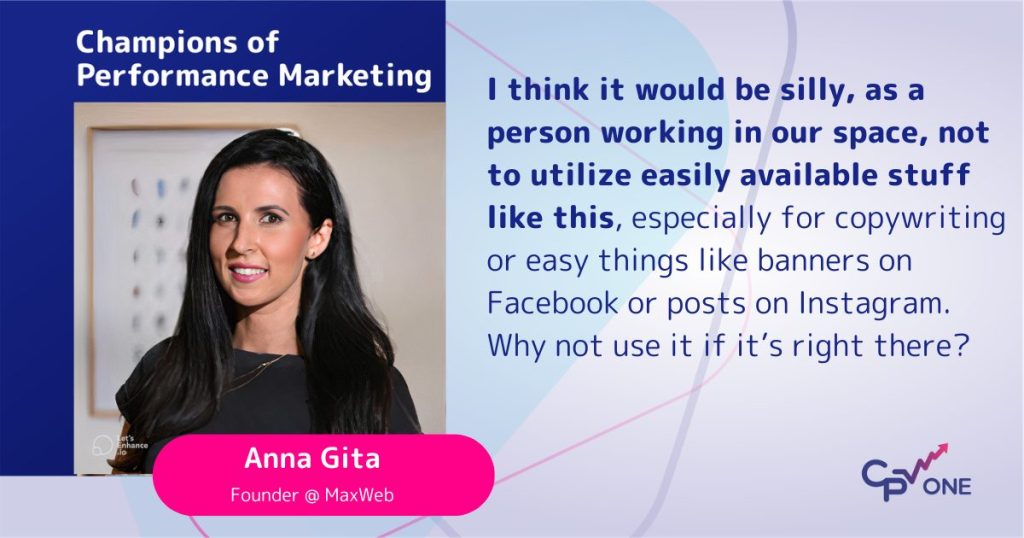
“I think it would be silly, as a person working in our space, not to utilize easily available stuff like this, especially for copywriting or easy things like banners on Facebook or posts on Instagram. Why not use it if it’s right there?”
— Anna Gita, Founder of MaxWeb, Anna Gita on Breaking Into Affiliate Marketing: A Journey from MBA to MaxWeb Success
The Bottom Line
AI tools like ChatGPT, Claude, and Gemini are force multipliers for media buyers.
AI for media buyers eliminates routine tasks, accelerates research, and helps you test more ideas faster. But they work best when you bring the strategy, industry knowledge, and quality control, and when you track everything so you know what’s actually working.
The marketers winning with AI aren’t using it to think for them. They’re using it to execute their ideas faster, turning one hour of ad copy writing into ten minutes, one day of competitor research into an hour, one week of email sequence creation into an afternoon.
Start with the use cases that match your biggest time drains. Master those workflows. Then expand.
The goal isn’t to use AI for everything, it’s to use AI where it genuinely makes you faster and better.