TL;DR:
- Kyle Dana has seen affiliate marketing from both sides. He built a list management business first and now leads digital strategy and growth at Digistore24.
- The affiliates who scale are testing angles and creatives “like crazy”, including hundreds of creatives a week, and they don’t give up after a month.
- Meta, YouTube, Google, native and email are still the main channels. ChatGPT ads is the one Kyle is watching.
- Nutra and BizOps are the two biggest verticals right now, and digital products are making a comeback, even in nutra.
- Vendors get better results when they test their offers before sending them to affiliates and when they look for the right affiliates, not hundreds of random ones.
- More US vendors are now selling in Europe, where traffic is cheaper and there is less competition.
Most people only see affiliate marketing from one side. You are either the affiliate running the campaigns, or the brand paying for the sales. Kyle Dana has been on both sides of the table.
Kyle is Director of Digital Strategy and Growth at Digistore24, one of the biggest affiliate networks out there. Before that, he built his own business as an affiliate and ran an email list management agency that worked with dozens of lists at the same time.
This episode is part of Champions of Performance Marketing, our performance marketing podcast where I talk with affiliates, media buyers, networks and brands about what is really working. If you follow affiliate marketing podcasts to stay current, this one gives you the network view that is hard to get anywhere else.
In Part 1, Kyle shares how he got into direct response through email, what he learned about running lists with AI, what surprised him when he moved to the network side, what separates successful affiliates from the ones who struggle, and which traffic sources and verticals are performing right now.
Let’s dive in.
Listen to the episode on our Spotify channel
Or watch it on CPV channel on Youtube
Q: Let’s start with your journey. Take us back to when you started. What were you doing, and how did you get into affiliate marketing?
Kyle Dana: My background is very similar to a lot of affiliates, or people in direct response in general. I worked in so many different industries and so many different jobs, all in online marketing.
Before that, I had a light bulb e-com site, selling light bulbs online. I worked in adult entertainment, sports betting, online casino and poker. So I did a lot of things. Then I got exposed to the world of direct response, specifically through email.
Before Digistore24, I was running a big list management agency. It was called Advertise Health at the time.
We did two things.
We worked with vendors who were selling their own products, to help them make more money from their email list. And a big way we generated revenue was by promoting affiliate offers. Let’s say there was a weight loss list. We would understand what other health issues that list had, and then we would sell different affiliate offers that provided a solution to that problem.
That’s how I got exposed to this world, through email marketing. Now I’m running strategy and growth at Digistore24, on the network side. So it’s been a fun last 10 years, for sure.
Q: So you ran these email lists with your own team? How did you work?
Kyle Dana: We had a small team. The most interesting thing we did, before AI became such a big thing, is that we built our own platform using AI.
Let’s say we managed 50 different lists. That’s a lot of lists. You have to know what product to send, when to send it, and to what segment.
So we built an AI platform where all the data from the networks and the email providers came into one place. From there, the AI figured out what to send based on past data. It looked at all the data on a per-list basis and decided, okay, tomorrow we’ll send this product to this list at this time. That was very powerful.
We still had a small team helping with campaigns and reporting, but the AI helped us save 90% of our time. That was huge, because managing 50 lists and sending twice every day is a lot of campaigns.
Q: Is sending two emails per day to the same list a lot?
Kyle Dana: It depends. My biggest thing, and I’ll say it throughout this podcast, is test. Test everything that you do.
In our case, there were times when we sent a third email: morning, lunchtime and evening. But it depends on your business. Two times a day is definitely a lot. There are times when you might want to send one email a day, or only a couple of emails a week.
I think the biggest thing for email is don’t send emails just to send emails.
But at the same time, there are so many vendors and affiliates with an email list who are not sending enough emails. I tell them, you can make so much more money if you send more campaigns a week.
One more thing. We were never sending to a full list, at least at the time. Every list had different segments, based on interest or behavior. If someone recently opened or clicked, that also helped determine who was getting emails.
Q: Where did these lists come from? Did you get them from vendors, or did you build them yourselves?
Kyle Dana: We did both. We worked with vendors who had buyers lists or abandoned carts. Anytime someone purchased their product, they would get added to the list, and we would manage that list on their behalf.
On the side, we also generated our own leads. We used to run paid campaigns with quiz funnels and things like that, and we built a diabetes list and a men’s health list. If the economics worked, we kept building, and then we would send affiliate offers to those lists and monetize them that way.
Julia’s Take: Kyle’s story lines up with what Jonathan Bouchard told us on the podcast: an email list is an asset you own, and competitors can copy your landing pages but not your list. If you want to go deeper, read Part 1 of my interview with Jonathan and his second part on email marketing success. And if you build a list with paid traffic like Kyle’s team did with quiz funnels, ad tracking matters even more. You need to know which source brings subscribers who actually buy later, not just the ones who sign up.
Q: Email always surprises me with how powerful it still is. Do you see it that way too?
Kyle Dana: It has become 10 times harder than it was even two years ago. But there is still so much money to be made with an email list, especially if you’re a vendor. Traffic is expensive, there is a lot of competition, and it’s very hard to make money on the front end.
Generally, vendors that are having success on Digistore24 have a whole back-end puzzle that is configured, a well-oiled machine. They have email, maybe SMS, they’re calling customers to sell more. That back-end piece is more important than ever.
Q: What made you move to Digistore24? Did you work with them before?
Kyle Dana: A couple of reasons. Before running the email agency, my background was more overarching marketing. I had run a very big content marketing team, and I had started a couple of my own businesses where I was kind of the head of marketing.
It was during COVID. I woke up one day and thought, email is great, there is a lot of money, but it was getting repetitive, and I wanted a new challenge. At the time, Digistore24 was really starting to grow in the US, and a lot of my old account managers had recently joined. When I was promoting products on ClickBank, for example, a lot of people from ClickBank went to Digistore24. So I knew a lot of people there, and their mission was exciting.
I was also an affiliate, so I was already familiar with the industry. It felt like a perfect fit. It has been around six years now, which feels like 25 years at a company in the old days, because a lot of people change jobs every year now.
Q: Now that you see things from the network side, what surprised you the most?
Kyle Dana: I kind of knew it when I was doing email, but how much money you can make in this industry is pretty incredible.
I would go to events and meet 20-year-olds doing $100,000 days. I thought, wow, that’s incredible. I wish I had started this 20 years ago, or straight out of school, to be honest.
After I joined Digistore24, I started going to a lot of industry events. What I like, compared to other industries I worked in, is that while it is very competitive, people love to help each other. You’ll see competitors exchanging insights and secrets together. That is very different from other industries I’ve worked in.
I also got a glimpse of the vendor side. As an affiliate, I just got my links and promoted, and with email that was very simple.
Now I see how much goes into running an online business where you sell your own products: the front end, the back end and everything in between. There are so many puzzle pieces, and it’s impressive to see vendors with everything dialed in and working together.
Q: What is the most difficult thing for vendors when they work with affiliates?
Kyle Dana: What surprised me is that a lot of vendors, at least in the past, didn’t really test their product.
They would make a VSL and a funnel, and they wouldn’t test it. They would say, “We have this amazing offer,” and send it to affiliates. The affiliates would promote it, not have success, and that relationship would get burned. Now, especially on Digistore24, I see vendors really testing their offers before going to affiliates. That’s definitely something I suggest. Make sure it converts first.
The other big thing is finding the right fit. Don’t just try to get a hundred different affiliates promoting. Try to find the right ones. If you put your product on Digistore24, we might be able to connect you with two or three affiliates who can scale traffic like crazy, as opposed to putting the offer on the marketplace and having any random affiliate promote it.
You could also be a vendor with a lot of success on different channels, but you haven’t been able to crack Meta, for example. We could connect you with an affiliate who is an expert on Meta, and all of a sudden you have that channel ticked off.
Q: Why is working with affiliates a good option for a brand, compared to an agency?
Kyle Dana: The best thing with affiliates, unlike an agency, is that you’re only paying them when they bring you a sale. It’s a fully performance-based channel. At the same time, you can define what you can afford to pay. Let’s say you can give this CPA or this revshare. You’re doing something that you know works economically for your business, and it works for the affiliate too.
An agency can burn through money very quickly. They have other goals in mind, like spending money. The affiliate is the opposite. They want to get sales as efficiently as possible. That’s why I think affiliates are an amazing channel.
The best thing with affiliates, unlike an agency, is you’re only paying them when they bring you a sale.
Q: From your experience on the network side, what separates the affiliates who are successful from the ones who struggle?
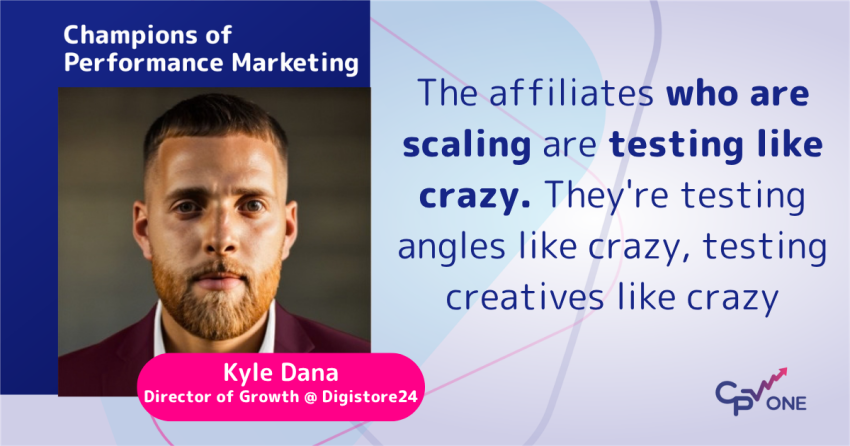
Kyle Dana: There are a couple of things. First, the affiliates who are scaling are generally doing paid ads, and they’re testing like crazy.
They’re not only testing different offers or channels, they’re testing angles like crazy. They’re testing creatives like crazy.
Take Meta as an example. They test very wide, and once they find interesting angles, they test tons of different creatives for those angles. They use AI as well, which goes hand in hand. They’re testing hundreds of creatives a week, figuring out what works, and then testing variations of those creatives.
That’s really important now because on a channel like Meta, the creatives and the copy you use help Meta determine who to target. It’s a big targeting lever right now. And by giving Meta more creatives, you give the algorithm more content it can decide is worth sharing.
The second thing is that the best affiliates are very resilient. So many new affiliates join Digistore24 and give up after a month. The ones who have success are always testing and working hard, consistently. Even if something doesn’t work, they go back to the drawing board and try a different strategy until they find something that works. Then they put fuel on that fire.
Julia’s Take: This is the opposite of the “post a link and make easy money” idea that still floats around. It’s work. Testing hundreds of creatives a week only pays off if you can tell which ones actually win, and that is where split testing and clean ad tracking come in. It is also the same rhythm Jane Ejim described when she said to treat creatives like milk, because they have a shelf life. If you also test the pages behind those ads, our guide on split testing landing pages shows how to do it inside your tracker.
Q: You mentioned that US vendors are looking at new markets. Tell us more about that.
Kyle Dana: In the last couple of years, it has gotten a lot harder to have success in the US. There is a lot of competition, traffic costs are very expensive, and it’s harder to get VSLs to convert. So a big thing we’ve seen at Digistore24 is US vendors now looking to sell in Europe.
If you work with Digistore24, you can sell in Europe because we’re the merchant of record. You don’t have to create your own entity or worry about things like taxes. If you already created a winning offer in the US, we’ll help you translate it and sell it in the German, French or Italian markets. That has really taken off in the last 18 months or so.
The cost of traffic is lower, but the big thing is that there is less competition. People in Europe maybe haven’t seen VSLs the way people in the US have, where they see a new VSL every day. So Europeans are not as saturated. It’s something kind of new for people living in Europe.
Julia’s Take: Kyle’s point matched something I heard firsthand recently. I was at the AWSummit conference in Bucharest, and during the Nutra panel, several speakers said the exact same thing: VSLs are now being tested in Europe, and nutra supplements are actively expanding here, especially in Germany and France. It’s not just a Digistore24 trend, it’s showing up across the industry right now. If you’re an affiliate or a vendor sitting on a proven US offer, this looks like a real window to get in early, before the market catches up the way it has in the US.
Q: Which channels are performing best for affiliates on Digistore24 right now?
Kyle Dana: For now, it’s the same channels as before. Meta is obviously big. YouTube and Google are big. Native is really big, and there are a lot of different platforms you can promote through with native. They’ve gotten harder, so the people who are having success are either very aggressive or very clean: e-com, branded, white hat. And of course, email is still a big one.
I haven’t seen any new traffic sources emerge, but one thing I’m keeping an eye on is ChatGPT ads, which has been rolling out. With Google search, your ad shows for a very specific query, like someone searching for “page builder online”.
With ChatGPT there is a lot more context. It might be someone saying, “I’m looking for a page builder, I want to spend $30 a month, and I’m in the coaching industry.” All of a sudden you have a lot more context you can use for your targeting. I’m curious to see what happens there.
There are still some affiliates who do organic, with a blog or a social media following. But the biggest affiliates, the ones we call super affiliates, are usually doing paid. They’re so good at paid ads that they can scale very fast and with big volume.
Julia’s Take: ChatGPT ads recently launched in Europe as well, and people are testing, but nobody has the full picture yet. We shared our early experience in ChatGPT Ads: First Impressions After Real Campaigns and in ChatGPT Ads Tracking: What We Saw Setting It Up With Our Users. With any new traffic source, set up your conversion tracking before you spend, so you can measure the very first tests.
Q: What verticals are hot on Digistore24 right now?
Kyle Dana: Nutra is always going to be really big. It’s always at the top or near the top. One change I’ve seen compared to when I was an affiliate is that weight loss isn’t as big now, because in the US you have things like GLP-1s and injections, where people can lose weight without taking a supplement. But nutra is still very big.
What has taken over the top spot, probably, is BizOps, the make-money-online type of offers. That goes in line with the economy: when the market isn’t doing well, people have fears about money, and they care more about making money than maybe about their health. Nutra and BizOps are the big two. BizOps has definitely been huge in the last year.
Another thing I’ve seen: when I first started as an affiliate, digital products were really big. Even for a diabetes product for blood sugar, they might sell an ebook instead of a supplement. Then it shifted to all supplements. Now digital products have made a big comeback, even in nutrition. Someone might sell a digital product on the front end and then a supplement as an upsell.
Q: How easy or hard is it for someone new to start with Digistore24?
Kyle Dana: I think it’s easier than ever, especially with AI. On Digistore24 it has always been simple. If you’re an affiliate, you can sign up in a minute or two, browse the marketplace, get your links and start promoting.
On the affiliate marketing side, we have a very cheap course, $10 a month, that teaches you everything you need to know about affiliate marketing. There are weekly calls led by very successful affiliates, and a private community. Anyone who signs up gets added to that community. They collaborate, exchange ideas, and make sure you don’t quit and stay accountable. When you purchase the course, you also get a page and funnel builder called PageWheel, so you can make an affiliate bridge page that’s included in your package. We really give you everything.
Outside of Digistore24, AI has made it so easy to create content, creatives and landing pages. More than ever, the barrier to entry is very, very low.
Q: What about the approval process, and how do you get to work with an account manager?
Kyle Dana: It’s very easy to start. The only thing is that you have to do some volume before you get a dedicated account manager who can really help you scale. Once you get to that level, it’s amazing, because our account managers are very experienced. They get to know your business, so they can recommend strategies or other offers you should be promoting.
Not every offer is on our affiliate marketplace. On the marketplace, any affiliate can sign up, and there are thousands of products from every niche you can think of. I think we have 44 different niches. But some vendors don’t want their product public, or they only want to work with a few affiliates. Once you have an account manager, I might say, “Hey Julia, we have this amazing new product that isn’t on the marketplace, but I can get you access. I think it will do really well for you.” Those offers often have very good payouts as well.
So getting started is very easy, and if you graduate to that level, we can really unlock big scale, with insights and private offers.
Q: What happens when vendors and affiliates really share information with each other?
Kyle Dana: That is a big thing I see on the platform side. There is huge success unlocked when a vendor and an affiliate can work closely together and have that relationship.
It could be that an affiliate gives a vendor an idea for a new lead in their VSL, or a different landing page that they create because of something the affiliate sees. That collaboration is definitely key. Everyone ends up making more money together.
“Everyone ends up making more money together.” – Kyle Dana, Digistore24
CONCLUSION
A few things stayed with me from the first half of my conversation with Kyle.
The first thing is how simple his view of success is. The affiliates who win test more, test faster and don’t quit after a month.
Kyle sees this every day from inside a network, and it matches what I hear on almost every episode of this performance marketing podcast. Tools and channels change, but the habit of testing and staying in the game does not.
The second thing is the idea that a good partnership beats a big number of partners. A vendor with two or three affiliates who can scale traffic will often do better than a marketplace full of random ones. When vendors and affiliates share what they learn, everyone earns more.
Here’s what to take away from Part 1:
Test everything. Angles, creatives, offers and channels.
The affiliates who scale test hundreds of creatives a week and use AI to speed that up.
Be resilient. Many new affiliates quit after a month, right before something could have worked.
Meta, YouTube, Google, native and email are still the main channels. Keep an eye on ChatGPT ads.
Nutra and BizOps lead the verticals right now, and digital products are back, even inside nutra.
Vendors should test their offers first and look for the right affiliates, not the most affiliates.
Email is harder than two years ago, but a strong back end still makes vendors money.
Europe, especially Germany and France, is an active growth market for VSLs and nutra right now, and it’s not just a Digistore24 trend. It’s showing up across industry events too.
In Part 2, Kyle and I get into whether email still works, the metrics affiliates should follow (and why CPC versus EPC matters), whether to send traffic straight to the VSL or through a pre-lander, what frustrates affiliates most about networks, why so many direct response brands are struggling right now, and Kyle’s two pieces of advice for anyone starting out.
If you promote Digistore24 offers, tracking is what tells you which campaigns to scale and which to stop.
CPV Lab and CPV One give you conversion tracking across every offer and traffic source. CPV One connects with Digistore24 through a server-to-server postback, so every sale is recorded automatically. See Digistore24’s own guide to setting up S2S postback.
Start your 14-day free trial here!
To follow Kyle and see what Digistore24 is doing with its events, find him on Instagram and Telegram: @thekyledana. You can also read his articles on the Digistore24 blog.
More episodes from Champions of Performance Marketing:
- Jonathan Bouchard on email lists and affiliate media buying (Part 1)
- Jonathan Bouchard on email marketing success (Part 2)
- Jane Ejim (ClickDealer) on scaling e-commerce campaigns
- Josh Littler on creatives, tracking gaps and using AI
See the whole interview on YouTube or on Spotify.
FAQ
What is the Champions of Performance Marketing podcast? Champions of Performance Marketing is a performance marketing and affiliate marketing podcast hosted by Julia Draghici, CEO of CPV Lab and CPV One. Each episode features an interview with an affiliate, media buyer, network or brand leader, and every interview is also published on the CPV Lab blog as a written Q&A.
Who is Kyle Dana? Kyle Dana is Director of Digital Strategy and Growth at Digistore24. Before joining the network, he built his own business as an affiliate and ran a list management agency that promoted affiliate offers to email lists.
What separates successful affiliates from the ones who struggle? According to Kyle Dana, successful affiliates test angles and creatives constantly, including hundreds of creatives a week, and they are resilient. Many new affiliates give up after a month, while the ones who succeed go back to the drawing board and try a different strategy.
What traffic sources work best for affiliates right now? Meta, YouTube, Google, native and email are still the main channels on Digistore24. Kyle also mentioned ChatGPT ads as a new source to watch, because it gives advertisers more context for targeting than a classic search query.
Which affiliate verticals are hot right now? Nutra and BizOps (make money online offers) are the two biggest verticals on Digistore24. Weight loss has slowed because of options like GLP-1 injections, and digital products have made a comeback, even in nutra.
How does someone get started with Digistore24 as an affiliate? Signing up takes a minute or two, and then you can browse the marketplace and start getting links. After you generate enough volume, you can get a dedicated account manager, who can also give you access to private offers that are not listed on the marketplace.
Can I track Digistore24 offers with CPV One or CPV Lab? Yes. Both CPV Lab and CPV One uses a server-to-server postback to record each Digistore24 sale automatically.

Author: Julia Draghici
Julia is the CEO of CPV Lab and CPV One ad trackers. She has 15+ years experience in the software industry, from development to management. For more than 8 years she is helping marketers get the best out of their marketing campaigns by using a performant ad tracker. Passionate about entrepreneurship, business and performance marketing, Julia loves helping people!