TL;DR:
- E-commerce affiliate marketing is creator-led and data-obsessed now, not the “coupon site and pray” approach it used to be.
- Retail and marketplaces are the reliable bread and butter, fashion and beauty bring high AOVs, dropshipping is the high risk, high reward wild card.
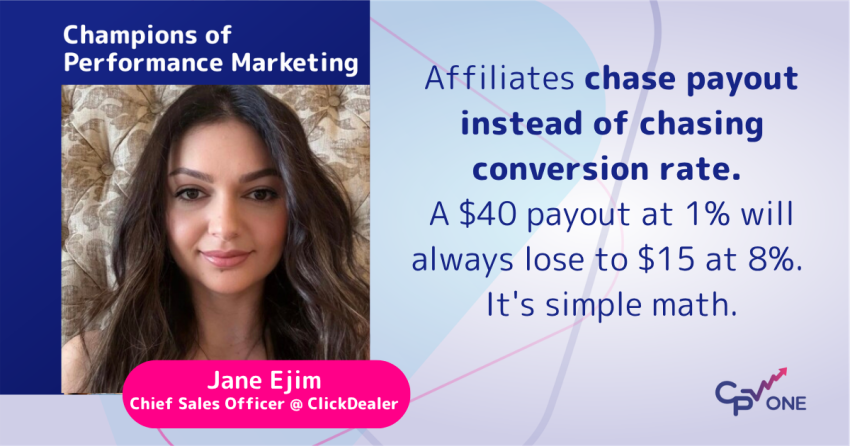
- Chasing the highest payout is a mistake. Affiliates should chase conversion rate instead: a $40 payout at 1% loses to a $15 payout at 8%.
- Brand safety and consistency come before anything else when a brand chooses an affiliate partner.
- Pinterest is an underused but high-performing traffic source for e-commerce right now.
- New affiliates should pick one vertical and go deep before spreading wide.
E-commerce is one of the biggest opportunities in affiliate marketing right now. But most affiliates are still chasing the wrong number.
ClickDealer is one of the leading global affiliate networks out there, working closely with premium e-commerce brands, advertisers, and affiliates to build campaigns and drive them to profit. If you want the full breakdown of the network itself, we already covered that in our ClickDealer review.
For this episode, I sat down with Jane Ejim, who has spent 13 years growing inside ClickDealer and now heads their e-commerce division as CEO of a new unit called Customer Direct Group, built specifically for direct-to-brand e-commerce partnerships.
In Part 1, we go beyond the basics. We talk about which e-commerce verticals are actually performing right now, what brands look for before they’ll work with an affiliate, which traffic sources are underrated (Pinterest might surprise you), and the one mistake Jane sees affiliates make every single day that quietly kills their profit.
If you’re in performance marketing, this one’s for you. Let’s dive in.
Listen to the episode on our Spotify channel
Or watch it on CPV channel on Youtube
Q: Let’s start with your journey. You’ve been in performance marketing for a while. How did you start, and how did you get to ClickDealer?
Jane Ejim: I’ve been in performance marketing for a long while. I joined ClickDealer back in early 2013, and I’ve basically grown within this industry. I’ve built verticals from spreadsheets, or a dream, you could say, into six or seven figure businesses, more than once. At this point, when I’m launching a vertical, I don’t get nervous, I get suspicious when it becomes too easy.
For 13 years, it’s been a while. And with one company, you grow through different things together, you learn together. My role right now at ClickDealer is heading the e-commerce division. I’m the CEO of a new unit called Customer Direct Group. It’s a unit we built specifically for direct-to-brand e-commerce partnerships, covering retail, fashion and beauty, travel, streaming, marketplaces, and dropshipping.
Q: What attracted you to e-commerce especially?
Jane Ejim: I’ve worked in different verticals for years, trying different ones, building them, and then leaving them to a team that would nurture them while I moved on to a new vertical. What attracted me to e-commerce is that it’s a white niche with amazing opportunities. It’s growing.
After Corona, everything went online, even the offline businesses, skincare, whatever services they had, they wanted people to buy online. And even after we were done with Corona, the trend kept going, because brands found out this is a golden opportunity where people keep coming through online services to purchase products.
Q: How do you see the e-commerce affiliate space today compared to three or five years ago? Is it easier or harder to succeed now?
Jane Ejim: I think it’s not about easier or harder, because it depends on the approach. We’ve jumped from an era where e-commerce affiliates used to slap a banner on a coupon site and pray. You also had to work that site, work that coupon and everything, so it was hard too.
Now, maybe it’s easier with all the technology available, but there are still a lot of challenges because user behavior is much different than it was before. Now it’s creator-led, it’s data-obsessed, and frankly, a lot more fun. Brands used to want outreach. Now they want relevance.
Through CDG, the unit we created, we’ve been working with our proprietary optimization technology and years of performance experience (ClickDealer started in 2012) to generate 2.5 million plus orders annually. And that’s not luck, that’s matchmaking done properly, between brands and the exact audience segments that convert for them. So I wouldn’t say it’s easier or harder, it’s more about the approach, and using the technology and instruments available right now.
Q: What categories or verticals are performing well in e-commerce today?
Jane Ejim: Retail and marketplaces are the bread and butter of the industry, they’re very reliable.
Fashion and beauty are very emotional verticals, users are triggered by emotions there, and they bring high AOVs and retention rates. Streaming and subscriptions are the cash cows, nobody brags about them, but everyone loves them.
Dropshipping is also a good vertical for us, but it’s a wild card, high risk, high reward. It’s not for the faint of heart.
Q: What are brands looking for in affiliate partners right now?
Jane Ejim: They don’t like surprises, that’s for sure. What they look for first is brand safety, that’s number one and non-negotiable. Nobody wants to see their logo next to nonsense.
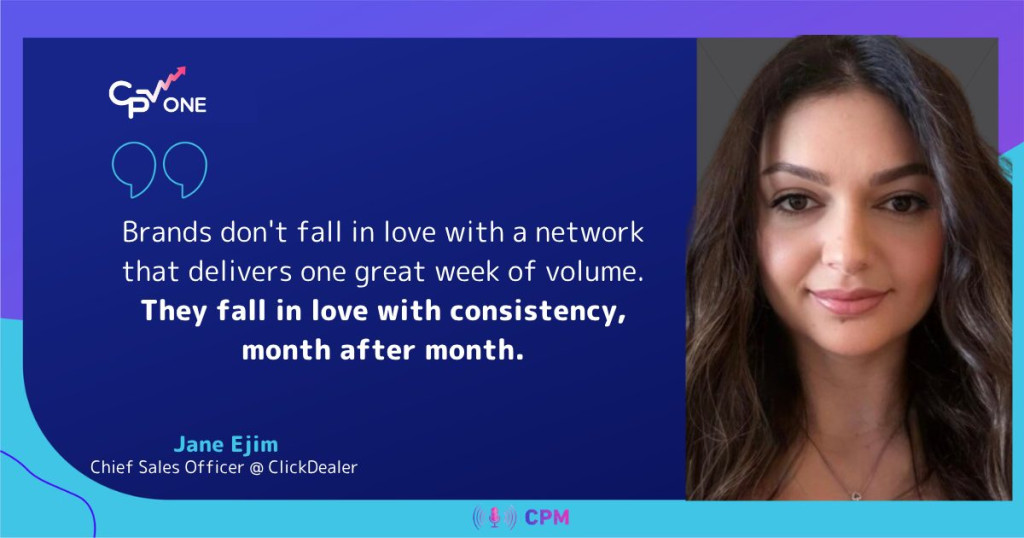
Number two is consistency. Our partners don’t fall in love with a network that delivers one great week of volume. They fall in love with us because we deliver on a monthly basis, and we keep up the quality month after month.
“Brand safety is number one and non-negotiable. Nobody wants to see their logo next to nonsense.” – Jane Ejim, ClickDealer
Q: What traffic sources are performing well right now?
Jane Ejim: Right now, I’d say creator-driven content and short-form video. On our side, we lean on a diverse supply mix, mainstream and niche influencers with transparent engagement metrics across every vertical, plus a strong bloggers and publishers layer, niche blog networks and editorial creators with real domain authority.
I’d also mention Pinterest affiliates. Pinterest is one of our best kept secrets, to be honest. They’re visual content specialists, mostly working with offers based in the United States. We work worldwide, but for Pinterest affiliates specifically, we mostly work with US-based offers.
With their visual content, they reach millions of monthly views, so they’re pretty great, and nobody talks about them.
We also have our own websites, blogs, coupon sites, and review sites, and we get a lot of audience there who read and purchase products later on.
Our own internal media buying team does SEO, display, and Meta traffic. With them we test offers first, mostly the smaller or medium brands where we need to understand how they convert and how to sell that offer to the right publisher. Big offers, from brands like Temu, Walmart, Shein, Paramount, or Tesco, don’t need much testing before going public because they already work and everybody wants them.
Julia’s Take: This is exactly why ad tracking across multiple sources matters so much. If you’re running creator content, Pinterest, SEO, and paid social at the same time, you need one place that tells you which source is actually sending you buyers, not just clicks. Without that, you’re splitting budget on gut feeling instead of data.
Q: How hard is it for an e-commerce brand to join ClickDealer?
Jane Ejim: It’s much harder, and the sales funnel is much longer, honestly, compared to other verticals. If we’re talking about nutra or sweepstakes, or even dropshipping, retail, fashion, and marketplace brands are much harder to bring on.
Big brands get pitched every day by all the networks that want to work with them, so before you get their attention, some time passes. Once you start discussing with them, you start on the surface, and then you need to prove yourself, show them why you’re better or different.
You prepare materials, show them where and how you’ll promote them, until you get approvals, then the contract signing, then setting up the tracking. Sometimes tracking alone takes about a month. To set up one big brand, it usually takes one to three months.
Sometimes brands reach out to us themselves, and that’s a great sign. This year especially, we’ve seen more brands reaching out after seeing our own websites and traffic. Word travels fast. When that happens, everything moves much faster, the tracking, the setup, everything gets smooth much quicker.
Q: What makes a good offer? What signals tell you it has potential?
Jane Ejim: I try to look at it from the media buyer’s perspective. What do they want? Really, only three things. A payout that respects their work, for e-commerce that could be a fixed payout or a rev share percentage. I look at that percentage, and I look at the brand, how big or small it is, and what countries it’s targeting.
We have brands that come from one country and want to sell fast in another where nobody knows them, that offer isn’t a fast winner, it needs work and consistency before it becomes one.
Then the offer itself, how established it is in that country, how long it’s been running. And from a media buyer’s perspective, I’m also thinking about the creative, it shouldn’t embarrass me.
And whether the advertiser actually pays on time. You’d be shocked how rare it is to get all three of those together.
I also want to share a mistake I see affiliates make, and I hope a lot of affiliates are listening, because I see this every day, not just in e-commerce, across every vertical. Affiliates are chasing payout instead of chasing conversion rate. Let’s make it simple:
“A $40 payout on an offer that converts at 1% will always lose to a $15 payout that converts at 8%. It’s simple math.” – Jane Ejim, ClickDealer
I urge every affiliate to stop looking only at the payout and start looking at the conversion rate too.
We test offers on the back end with our own media buyers, and we check the conversion rate, the traffic sources, everything, so we’re prepared when affiliates come to us. Some offers need more work and consistency before they show great results, others are immediate winners they can run and make money on right away.
Julia’s Take: This is the whole reason conversion tracking exists. Payout is the number everyone sees first, but it’s the easiest one to be misled by. If your tracker isn’t showing you real conversion rate per offer, per traffic source, you’re picking offers based on the wrong number, exactly like Jane just described.
Q: For these offers, do you provide affiliates with landing pages and creatives, or do the brands provide them?
Jane Ejim: We do have a lot of brands and a lot of affiliates.
If we’ve tested creatives ourselves, we show them as examples, because at the end of the day, an affiliate or publisher is also like an influencer or creator, they have their own style, their own way of presenting things. We wouldn’t just hand them a copy-paste version, because then why would they even need to work with us, we could just run our own media. We need a fresh look, a new perspective from them.
That said, we do share the basics of what should be on the landing page, how it should look. Sometimes brands provide that too, but big brands mostly want a fresh look as well.
Q: What about paid ads as a traffic source?
Jane Ejim: Paid ads are the old and trusted source for every vertical, but here it’s a bit different, because you need to make sure you’re promoting the brand safely. You need to avoid any trademark bidding or misleading creatives, brands are very sensitive in e-commerce.
Q: With AI getting so much attention, is SEO still working for e-commerce?
Jane Ejim: Honestly, it’s still working. I get asked this at conferences too. More people are talking to AI, and everyone’s saying AI will soon be recommending products, and we need to understand how to work with these AI chats.
But SEO didn’t go anywhere. Maybe for some offers it decreased, but for retail, fashion, and marketplaces, people still search. They might ask AI first, but once they know where to find an item, on Temu or Shein for example, they go and search for it directly in search engines. It still works.
When we look at the keywords people use to find our brands, a lot of it is generic, like “I want to buy a red lipstick.” They combine the product with the intent, and that’s how they find it.
Q: Any recommendation for affiliates who want to try e-commerce for the first time?
Jane Ejim: Pick one vertical. If you’re coming from a different vertical and want to try e-commerce, you’re welcome, it’s easy to get into. But pick one. Go deep before you go wide.
I’d rather work with someone who’s mastered fashion and beauty than someone who spreads thin across every category and barely understands what works and how. Marketplace, fashion, beauty, they each have their own audience.
That’s what it takes to understand how e-commerce works. You need to understand retention rate, your audience is more sophisticated, more detailed than in other verticals. Data literacy is very important, and creative instinct comes with time.
“Data literacy and creative instinct together, not separately. Together, that’s a winning card for affiliates.” – Jane Ejim, ClickDealer
Q: How difficult is it for affiliates to join ClickDealer?
Jane Ejim: It’s actually not hard at all.
They come to our network, apply to be a new affiliate or apply for a new vertical. They need to come prepared.
Our affiliate managers try to be on top of everything and talk to every new affiliate within 24 hours. What we need from the affiliate is clear traffic sources and a real track record, even if it’s in a different vertical, that’s fine, it just helps us understand if they have experience in the industry at all. If they don’t, that’s also an answer, and we know how to guide them from there.
We need them to be transparent about their traffic sources and their track record, and to have realistic expectations. Then it goes easy, and it’s very fast. We try to help our affiliates.
Q: What types of creatives are getting the best results today?
Jane Ejim: UGC is one of the creatives people buy into. It still wins the trust game, let me put it that way. People buy from people, not from a polished studio shot, so the trust level for UGC creatives is the highest right now. UGC and creator content work best for cold traffic and trust building.
Then you have short video, it’s working really well right now, especially when the brand needs storytelling, and it really stops the scroll. Static creatives are more for retargeting, for warm audiences that need to be reminded.
Julia’s Take: This is also where split testing landing pages comes in. Knowing UGC beats a polished shot is only half the picture, you also need to know which landing page that UGC ad sends people to actually converts best. A tracker that lets you split test your landing page variations tells you that with real numbers, not a guess.
Conclusion
This is what stayed with me from this conversation with Jane.
Affiliates love to talk about payout. It’s the number on the offer page, it’s easy to compare, it feels concrete. But Jane’s math says it all: a $40 payout converting at 1% loses to a $15 payout converting at 8%, every time. If you’re only shopping for the highest payout, you might be walking past your best offer without even knowing it.
The other thing that stayed with me is her advice to newcomers: pick one vertical, and go deep before you go wide. It’s tempting to spread across fashion, beauty, streaming, and dropshipping all at once when you’re starting out. But Jane would rather work with someone who’s mastered one vertical than someone who barely understands five.
Here’s what to take away from Part 1:
E-commerce affiliate marketing is creator-led and data-obsessed now, not the coupon-site-and-pray era it used to be.
Retail and marketplaces are the reliable bread and butter, fashion and beauty bring emotion and high AOVs, dropshipping is the high risk, high reward wild card.
Brand safety and consistency come before anything else when a brand chooses to work with you.
Pinterest is quietly one of the best traffic sources in e-commerce right now, and almost nobody talks about it.
Chase conversion rate, not payout. That single mindset shift can change your entire bottom line.
Pick one vertical and go deep before you go wide.
And if you want to get in touch with Jane, reach out on Linkedin or on Clickdealer. She will help you out start with ecommerce offers!
In Part 2, Jane and I get into how often you actually need to refresh your creatives, the exact signals that tell you a campaign is ready to scale, why tracking and attribution are non-negotiable for e-commerce brands, and a real campaign that went from a cold start to millions of dollars a month.
Now, if you’re running e-commerce affiliate campaigns and you’re still deciding what to promote based on payout alone, you’re leaving money on the table. CPV Lab and CPV One give you real conversion tracking across every offer and every traffic source, so you know exactly what’s converting, not just what pays the most.
If you’re running ClickDealer offers specifically, both CPV Lab and CPV One connect directly with ClickDealer, so every click, conversion, and payout flows straight into your tracker. Check our step by step ClickDealer integration guide to get it set up in minutes.
Start your 14-day free trial here!
See the whole interview on YouTube or on Spotify.
This interview is part of our ongoing Champions of Performance Marketing series featuring marketing experts who share actionable strategies you can implement today. Subscribe to our newsletter so we can notify you when we release our next expert interview.
FAQ
What is e-commerce affiliate marketing?
E-commerce affiliate marketing is when affiliates promote online retail, fashion, beauty, streaming, or marketplace brands and earn a commission, either a fixed payout or a percentage of revenue, for the sales or leads they generate.
Is e-commerce affiliate marketing still profitable in 2026?
Yes. According to Jane Ejim from ClickDealer, e-commerce has become a white niche with strong, evergreen demand since the shift to online shopping during Covid. Verticals like retail, marketplaces, fashion, and beauty continue to perform reliably.
Should affiliates focus on payout or conversion rate when picking an offer?
Conversion rate matters more than payout. A lower payout offer with a high conversion rate can outperform a high payout offer with a low conversion rate. Tracking conversion rate accurately requires proper conversion tracking on every offer and traffic source.
What traffic sources work best for e-commerce affiliate offers?
Creator-driven content and short-form video currently perform well, along with Pinterest, which remains underused despite strong visual engagement. Paid search and SEO still convert well for retail and marketplace offers too.
How long does it take for a brand to get set up with an affiliate network like ClickDealer?
Setting up one larger e-commerce brand, including approvals, contracts, and tracking setup, typically takes one to three months.
Should new affiliates try to run multiple e-commerce verticals at once?
No. The recommendation is to pick one vertical and go deep before going wide. Understanding retention rates, audience behavior, and creative style takes focus, and spreading across too many verticals too early makes it harder to succeed in any of them.
Can I track ClickDealer offers with CPV Lab or CPV One?
Yes. Both CPV Lab and CPV One ad trackers integrate directly with ClickDealer, so clicks, conversions, and payouts sync straight into your tracker. Follow the step by step ClickDealer integration guide to connect your account.