We have another episode of Champions of Performance Marketing with Luke King. And I have to say, this one felt different from the very first minute.
I’m sitting down with Luke King, founder of affLIFT, one of the largest affiliate marketing communities running today.
Luke started in this industry when he was around 15 years old. He was building websites before anyone was calling it content creation, managing accounts at an affiliate network while still in high school, and running his own campaigns on the side. Over two decades later, he’s never left.
What drew me to Luke’s story isn’t just affLIFT’s scale or its eight years of continuous growth.
It’s the philosophy behind it.
In an industry that runs on big egos and protected secrets, Luke built something that actively pushes the other direction, a $20/month community where an affiliate in India has the same access as a super affiliate spending six figures a day. And he personally emails every single person who cancels their membership. Everyone.
In this first part of our conversation, we cover how Luke got into affiliate marketing, the real story behind affLIFT’s launch, what he does to keep a community engaged after nearly eight years, what affiliates at every level tend to get wrong, and which traffic sources and verticals are actually producing results right now.
Listen to the episode on our Spotify channel
Q: How did you get into affiliate marketing? What’s your story?
Luke King: I’ve been doing affiliate marketing for a very, very long time. I got my start when I was probably 15, over 20 years ago now. I was building websites. I’ve always been interested in building websites and just trying to publish things. Back in the day, you didn’t even call it content. It was just putting anything on the web and making it visible to everyone else. That always fascinated me since I was little.
Eventually, I got to the point where I was ready to try to monetize those websites, and I landed on affiliate marketing. I’ve done pretty much every aspect of the industry since then.
Originally, I started by working for an affiliate network when I was in high school, as an affiliate manager. I worked remotely, and this was when I was about 15 or 16 years old. That’s actually where I really got my start. I did a little affiliate marketing on the side, but the network role was where it began. And I’ve never really left the industry.
Q: How did affLIFT come to life? What was the original idea?
Luke King: I was an affiliate manager at PeerFly, a very large affiliate network I helped build from the start. At one point, I was managing around 30,000 to 40,000 accounts. When you’re managing that many, you get a massive volume of emails every day, and a lot of what people were asking me was the same. Common questions kept repeating.
So I launched a blog. I answered the questions I was seeing most often and shared my experience both as an affiliate manager and as someone running my own campaigns. I built an audience around that. Then I started thinking about building a community.
I was a member of some free affiliate marketing forums at the time, and I’d also joined a couple of paid ones. This was around 2018.
It was clear there was an opportunity for a middle ground. The free forums were packed with spam. Some good content existed, but for the most part, they weren’t great. The paid forums were solid, but they ran $100 to $200 a month. That was outside what a lot of the affiliates I worked with could afford.
So I wanted to build something in between: an affordable forum with premium content. Charge $20 a month so that anyone could join.
I wanted it to be something where members could actually be ROI-positive on their membership: join, read, apply it, and make back more than they paid me. This was actually a year before PeerFly shut down. I obviously didn’t know PeerFly was going to shut down. It was never my goal for affLIFT to be a business. I was just hoping it would cover the cost of the servers. And then it kind of blew up.
Q: So it started as a side project, not a real business?
Luke King: One hundred percent. At the time, I had my full-time job at PeerFly, where I was the director of marketing. I also had a side project called FP Traffic, a social media marketing tool that was doing really well. I was actually making more from FP Traffic than from my full-time salary. So I had a full-time job, a side project that was outearning it, and then affLIFT just popped into my head.
I actually don’t remember exactly what sparked it. I remember having a conversation with Chad, the owner of PeerFly at the time, saying I was interested in building something like this, thinking it could be useful for publishers, good for PeerFly, and something the industry needed. So I launched it as a side project.
When PeerFly eventually shut down, affLIFT wasn’t quite big enough to fully support me on its own yet. But I had FP Traffic and revenue from my own affiliate marketing, so I decided to go full-time on my own projects rather than find a new job. Now, affLIFT is my biggest business and takes up pretty much all of my time.
Q: Is FP Traffic still active?
Luke King: It still exists. I still have customers using it. With everything happening with AI and AI-assisted programming, I’m actually looking at potentially reviving that project. It launched back in 2013, so it’s pretty old at this point, but it still works well. It doesn’t take up much of my time right now. By far, affLIFT is where most of my focus goes.
Q: Eight years in, what actually makes affLIFT different from other communities?
Luke King: Since the beginning, I wanted it to be helpful, friendly, and affordable enough that anyone could get a real return on their membership. That hasn’t changed.
When I launched, I had no ambition to turn it into a business. Now that it is one, my goal is still the same: I just want it to be a useful resource for everyone in affiliate marketing. I don’t want there to be a barrier for an affiliate in India. I want them to be able to pay for their membership, participate, learn, and earn revenue from what they learn. That matters to me.
What I think really sets affLIFT apart now is the content.
Next month we’ll be celebrating eight years since I launched it. Over those eight years, with a team of community leaders and a huge number of contributing members, we’ve built what I genuinely believe is the most comprehensive resource for affiliate marketing available anywhere.
We have guides, case studies, and example campaigns for just about every type of campaign and every question you could think of.
The follow-along campaigns are especially good: a member sets up a real campaign, posts it on the forum, and the community follows along and gives feedback.
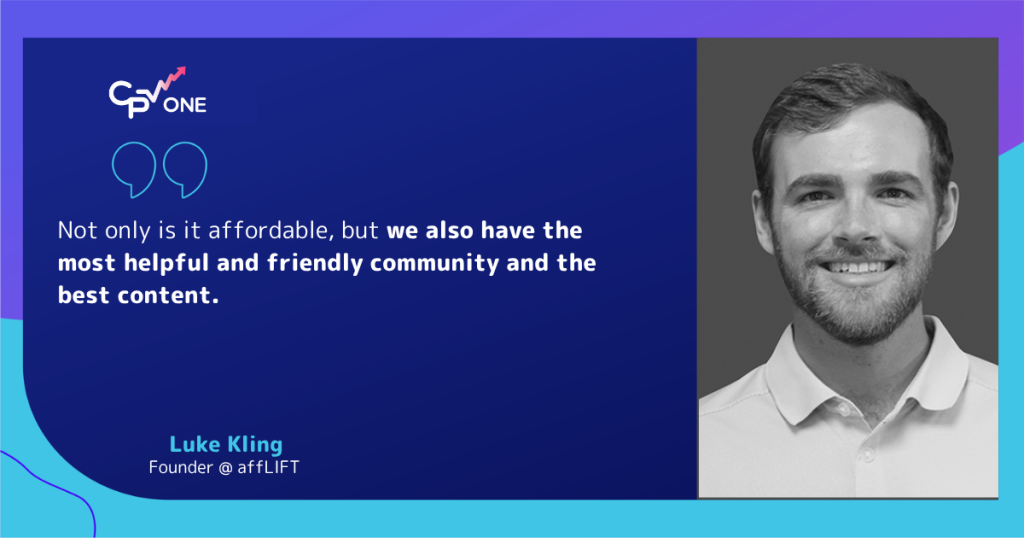
Not only is it affordable, but we also have the most helpful and friendly community and the best content.
At this point, I think we’re kind of in our own league, and I’m not saying that to pat myself on the back. I truly believe there’s nothing else in the industry quite like affLIFT.
The culture is something I’ve worked hard to shape too. The affiliate industry has always had a lot of big egos, people who are making good money and want everyone to know it, buying Lamborghinis and making sure people see it.
That’s never been what affLIFT is about. I’ve actively worked to push that out. If you’re not willing to share, if you’re not willing to contribute, we don’t really need you in the community. We have members who make far more money than I do, and you would never know it.
Q: Keeping a community engaged for nearly eight years is genuinely hard. What’s your secret?
Luke King: Running a community and a forum is harder than I probably expected when I launched it. And it hasn’t gotten any easier over the years. There’s still a lot that goes into retaining members, keeping people active, and bringing in new people.
In our industry, there’s also a natural cycle. I feel like the average affiliate’s lifespan in the industry, when they start brand new, is about six months. If they’re not making money within six months, they’re gone. Most people that are in this industry understand this, especially an affiliate manager who sees it all the time.
Here’s something I’ll share as a freebie for everyone reading this: constantly engaging people, even the ones who’ve left, by providing value can bring them back.
On affLIFT, if someone cancels their membership, I still send them content. And I personally reach out to every single person who has canceled since day one.
If you go and cancel your affLIFT membership right now, probably within 24 hours, you’re going to get an email from me. That’s not an automated email. I reach out to every single person that cancels because I want them to know I’m still here to try to help.
I want that line of communication to stay open. Ten months from now, if they reply to one of those emails, I’m still going to respond.
It’s so much easier to get someone who has paid you before to pay you again than it is to find someone brand new.
Here’s how it plays out in practice: someone cancels today. Over the next ten months, they’re getting two, sometimes three emails from me every single week. Then one day they see something on Facebook that sparks something, something affiliate marketing related, and they come back, resubscribe, go straight to the forum looking for information about that topic.
Maybe they start a new thread: “Hey, I just saw this on Facebook. Is anybody doing this?” That’s exactly what I want affLIFT to be for people. It doesn’t always work. Not everyone comes back. But it’s worth doing every time.
Q: What do you see affiliates struggling with the most right now?
Luke King: It depends a lot on the level of the affiliate.
For beginners, even with how much technology has advanced and what AI can now do, you’d think the basics, like setting up a postback URL, would be easy by now. They’re not. It’s still a complicated process for someone walking in the door for the first time.
Not everyone joining affiliate marketing is technologically savvy. They’re just trying to supplement their income; they read about something and want to try it. That technical barrier is still there for a lot of people, and I don’t think AI or anything else is going to completely remove it. What we do is try to provide guides, examples, and some hand-holding with that first campaign setup.
Once someone gets past that stage, the next challenge is figuring out what to promote and where. A lot of affiliates just don’t fully get it yet. They’ll try something that someone with experience can immediately see won’t work, like running a smart link on Facebook, for example.
And I’ll actually admit that’s worked well for some of our members recently, so maybe that’s a bad example. But the pattern holds: affiliates try things without thinking through why that offer-and-traffic combination doesn’t make sense.
We see this constantly through our follow-along contests on the forum.
The format is simple: set up a campaign, post about it, and you’re entered into a contest to earn prize money. And people jump in and run whatever campaign pops into their heads.
You see what they set up, and you’re like, ‘OK, that’s not going to work. ‘You should probably try something else. But that’s also how people learn, and the community feedback is what makes it valuable.
For more experienced affiliates, the problems are completely different.
Right now, a lot of people are struggling with Facebook account bans. One of the things I like about affLIFT is that all these levels mix in the same discussions.
Experienced affiliates reply to simple questions, and newcomers pop up in very advanced threads asking how someone did something. That cross-pollination is genuinely useful for everyone.
Q: Do you have traffic source recommendations for someone starting out or looking to scale?
Luke King: Every year, we run what we call the PEAK Awards, an industry survey where we ask our members and anyone else in the affiliate space who’ll respond, “Who are you working with?” What’s your favorite traffic source? Where are you seeing the best results?
Propeller Ads has won every single year we’ve done it, and I’m not going to disagree with the results. The traffic quality is genuinely solid. A newcomer can sign up and run a campaign, and they’re pretty much guaranteed to see their first conversion. It won’t necessarily be a profitable campaign, but the traffic converts, and that’s an important confidence builder. They also have multiple ad formats to test.
When someone asks me what traffic source they should try, my typical response is, ‘Are you using Propeller Ads?’ If they are and they’re having success and looking to scale somewhere else, then we start talking about ad formats and what’s working and try to lead them in the right direction from there.
Beyond that, the answer really depends on what kind of campaign someone wants to run.
An adult campaign gets a different answer than a mainstream one.
Push notification traffic is its own conversation.
And things genuinely change.
Last year, I started seeing a lot of discussion on the forum about Hilltop Ads, so I ran campaigns there myself. Went really well. I’d known about Hilltop for years, had even made a video about them at some point, but hadn’t used them in a while. All of a sudden, their publisher quality picked up, affiliates noticed, and I said, “Let’s give that a shot.”
Our industry is a roller coaster. If you’re in it, you’ve heard that phrase. It’s constantly changing, which is one of the things I genuinely love about it. You always have to be looking around and paying attention to what’s working right now.
Q: People keep saying affiliate marketing is dying. What’s your take?
Luke King: The affiliate industry is more of a frontier than a dying one. Affiliates were running campaigns on Facebook before pretty much anyone else was. That’s just how it tends to go. We try the new things first. We’re experimenting constantly, testing what works. And then eventually big brands and big companies come along, see it working, and decide they should be buying ads there too.
When that happens, it gets more complicated for the affiliate.
The big brands have big budgets, and they’ll dump money into a platform regardless of what the profit looks like, which drives up costs. So we (affiliates) have to look around and figure out what’s next. That cycle is one of the main reasons our industry is constantly changing.
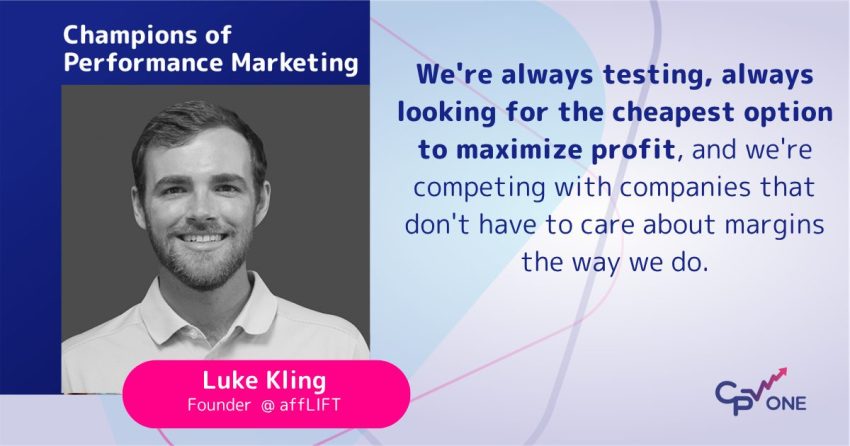
We’re always testing, always looking for the cheapest option to drive the highest profit, and we’re competing with companies that don’t have to care about margins the way we do.
People have been saying the affiliate industry is dead since I started in it. That was two decades ago. We’re still here.
Q: Should affiliates start with mainstream traffic sources like Facebook or something more affiliate-friendly?
Luke King: I typically recommend starting with the more affiliate-friendly traffic sources. Mainstream traffic sources, for the most part, are not affiliate-friendly. My recommendation for a new or even an intermediate affiliate is to work with companies like Propeller Ads or the traffic sources that are active and engaged on the forum.
And I want to be clear about something: I’m not recommending Propeller Ads because they’re paying for an affLIFT membership. If they weren’t on affLIFT at all, I would still be recommending them. I recommend the companies on the forum because they’re there, they provide real value to affiliates, and they actually want to work with affiliates. An affiliate is going to want to start with traffic sources that want them there. So, typically, I’d recommend something like Propeller Ads, AdCash, Hilltop Ads, or other affiliate-friendly sources over going straight to Facebook or another mainstream platform.
Once you’re ready to scale, or if you’re an experienced affiliate who is willing to deal with the possibility of getting an account banned, then go ahead and try Facebook. We had a lot of members last year who did really well there and were posting about it on the forum. It’s definitely possible. It’s just not what I’d tell someone brand new to try first.
Q: What verticals are you seeing grow lately?
Luke King: The vertical depends on the ad format and what you’re focused on, but a few stand out right now.
VPN is still going strong. Especially with internet security being a growing concern, the pop networks are getting a lot of VPN ads that are performing well. Browser-based games are doing well, too. In the adult market, adult games are performing, along with video-type sites and AI girlfriend products. There are a lot of those companies showing up right now, which tells you something.
You don’t see a bunch of companies popping up in the same vertical unless that vertical is making money. Years ago, it was Chrome extensions. You’d go to Affiliate Summit, and one in every eight people you talked to was doing something with Chrome extensions. Right now, that same concentration is in the AI space: AI companions, AI assistants, AI girlfriends, and tools built around AI.
Carrier billing offers are still active, too. Keep in mind that a lot of the conversation on affLIFT is around pop and push traffic, which means the offers need to be fairly generic, something that will work for basically any website or any user who lands there. For that type of traffic, surveys and similar broad-appeal offers tend to do well.
Q: How do you find and choose an offer? Affiliate network or direct with a brand?
Luke King: For most affiliates starting out or at an intermediate level, an affiliate network is the natural starting point. The PEAK Awards cover top affiliate networks too, the ones most popular with forum members and the broader affiliate community, so those are the ones I’d look at first. Sign up, create an account, see what they have, reach out to an account manager, or search for offers on Offer Vault. Research which networks are currently popular and what types of offers they carry.
That said, I’ve been telling people lately that because things are so competitive, there’s another path worth thinking about. Zeydoo, which is Propeller Ads’ affiliate network, is a great example: they have offers that perform well, but literally everyone is running those same offers. It’s extremely competitive.
So maybe you want to look for more of a direct affiliate program that you can work with instead of trying to compete with everybody else on the survey offer.
On affLIFT we have affiliate programs joining every single day. We have a directory of them. And that’s a way to try to work more directly with an advertiser and get a little bit of an edge, because it’s not going to be as competitive.
Working more directly with an advertiser takes more effort and is less diversified than joining a network. But the competition level is much lower. It makes sense if you’re willing to put in that extra work.
Q: Does building a relationship with an affiliate manager actually make a difference?
Luke King: It can go a long way. I have a background as an affiliate manager myself, so I’ve built solid relationships with account managers and affiliate managers at pretty much every major affiliate network. They’ll reach out to me when something new seems to be working well, or when they’re excited about a new offer or advertiser they’re bringing on. They’ll reach out and say: ” Hey Luke, we’re about to start this campaign with XYZ.” Is this something you’d be interested in trying? And typically, my answer is yes. I want to go test it before everybody else does.
It’s not always about getting a private offer before it goes public. That’s less common than people might think. It’s more often just a heads-up.
The affiliate manager just wants to get a couple of good affiliates on board so that once the offer is ready, it’ll get initial traction right away. They don’t want a new offer on their network just sitting there, for a month with nobody running it. Building a genuine relationship with your affiliate managers is one of those things that quietly pays off over time.
What’s coming in Part 2
In Part 2, we get into the operational specifics: when to use a landing page vs. a direct link, how many creatives to test on push traffic, what ROI number Luke actually uses to decide whether a campaign is worth scaling, and the AI assistant he built that monitors his campaigns and forum around the clock. We also cover what he tells every person starting in affiliate marketing for the first time. It’s not the answer most people expect.
Stay tuned for Part 2 of our Champions of Performance Marketing conversation with Luke King.
If you want to listen the full interview, go on Spotify or Youtube.
In the meantime, you can connect with Luke at:
affLIFT.com (A-F-F-L-I-F-T.com). When you register, you’ll get a welcome message from him directly.
luke@ afflift.com. He reads and responds to everything.
Check other interviews of the Champions of Performance Marketing on our blog and subscribe to our YouTube channel to not miss important updates and tips for CPV Lab and CPV One, or another episode with our champions.

Author: Julia Draghici
Julia is the CEO of CPV Lab and CPV One ad trackers. She has 15+ years experience in the software industry, from development to management. For more than 7 years she is helping marketers get the best out of their marketing campaigns by using a performant ad tracker. Passionate about entrepreneurship, business and performance marketing, Julia loves helping people!