TL;DR:
- Mikhail Zhukov, head of the CPM department at Adsterra, has worked at the ad network for 8 years and has focused on iGaming for more than 6 of them.
- Mikhail says iGaming is growing year by year and is easier to get into today than e-commerce, VPN, utilities or Nutra, because the audience is big and the products are well developed.
- Esports and betting use similar mechanics, but esports audiences are younger (14 to 35) and have a lower LTV, and the motivation is different: players want in-game currency, not cash.
- Asia (Indonesia, Vietnam, India, Pakistan, Malaysia, Korea and Japan) is the region Mikhail finds most interesting right now, because regulation is lighter and few affiliates have explored it.
- Beginners should start with RevShare, not CPA, and choose a well-known brand in the local market. Running worldwide traffic on one link can burn a budget in one or two hours.
- Creatives must match the local culture and language. In Asia, lucky numbers and the color red work well, and AI now makes translation and adaptation easy.
iGaming looks shiny and attractive from the outside. It is also one of the largest verticals in the affiliate world, and one with many ways to lose money if you start the wrong way.
Mikhail Zhukov spends his days looking at what makes campaigns work and what kills them. He is head of the CPM department at Adsterra, where he has worked for 8 years. For more than 6 of those years he has worked mostly with iGaming.
This episode is part of Champions of Performance Marketing, our performance marketing podcast where I talk with affiliates, media buyers, networks and brands about what is really working. If you listen to affiliate marketing podcasts to stay current, this one gives you the ad network view on a vertical that many people find hard to read at the start.
In Part 1, Mikhail shares how he got into affiliate marketing, where iGaming sits among other verticals, how it compares with e-commerce and esports, which GEOs look interesting, why creatives must be local, and how a beginner can pick a first offer.
Let’s dive in.
Listen to the episode on our Spotify channel
Or watch it on CPV channel on Youtube
Q: Tell us a little about how you started in affiliate marketing.
Mikhail Zhukov: It is a long path for me. I have worked in the Adsterra network for eight years in a row, and for more than six years I have worked mostly with iGaming, as one of Adsterra’s iGaming experts. My first education was history, with a bachelor’s degree, and then I did a master’s degree in marketing.
One day I decided to find out what affiliate marketing is, and it took me completely, with all my attention and my lifestyle. Now I am here, talking about verticals and how affiliate marketing works, and helping people earn money. I feel good in this way.
Q: Adsterra works with many verticals. Where does iGaming sit right now? Is it growing, getting more competitive, or both?
Mikhail Zhukov: iGaming is a huge one. We are not really surprised, but iGaming is growing year by year. We never thought the iGaming vertical would become one of the largest and biggest in the affiliate world, and I am not speaking only about Adsterra.
Some people look at Adsterra and think we are only about iGaming, but that is not true. We do our best with iGaming because it is growing and it is popular. We work on it in a few ways: education, showing cases, expert interviews, and taking part in iGaming conferences.
It is really interesting to dive into iGaming, because there are many ways it works, many things we need to know, and a lot to do to be on top of the market.
Q: What makes iGaming so different from other verticals like e-commerce or lead generation?
Mikhail Zhukov: We can look at it from different sides. One of the most important is popularity and the size of the audience. The other is how the operators and developers make their products. In iGaming the products are highly developed and high quality, and they bring a lot of satisfaction to the people who use them.
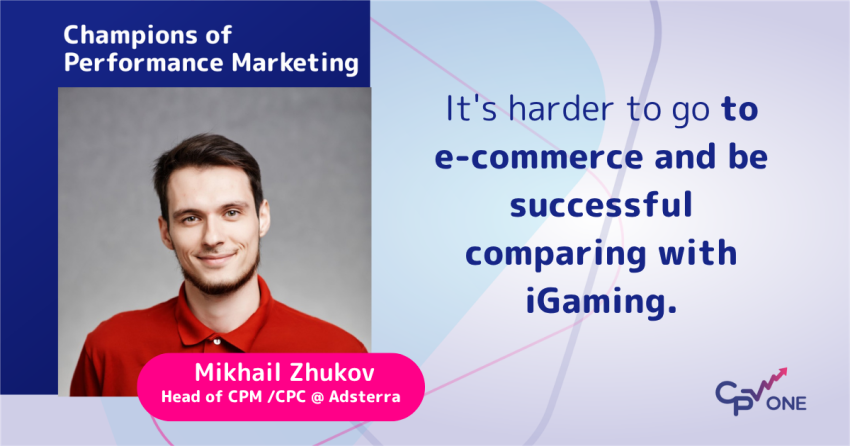
E-commerce is one of the oldest and most experienced verticals, so it is really hard to go into e-commerce and be successful compared with iGaming. In iGaming you have to know a lot of things, but today it is easier than knowing everything about e-commerce, VPN, utilities or Nutra.
Julia: I thought e-commerce would be the easy one, because everybody buys things. iGaming is harder to understand at the beginning, but you say it is more rewarding.
Mikhail Zhukov: Yes, it is more rewarding.
In e-commerce, if you know the markets, the audience, which deep links work and where you can get more commission, you will be successful.
But in iGaming you can make just a few moves, find the right audience, and bring a lot of revenue to your side with RevShare or CPA deals. From my point of view and from my experience, working with iGaming today is a bit easier than e-commerce.
Julia’s Take: I did not expect this answer, and I like that Mikhail is clear it is his experience, not a rule for everyone. If you want the e-commerce side of the comparison, read my interview with Jane Ejim about scaling e-commerce campaigns at ClickDealer.
Q: What is the main difference between iGaming and esports?
Mikhail Zhukov: They are pretty similar.
If we divide iGaming into parts, like casinos and betting, the betting mechanics are close to esports. Adults watch football matches with professional players who play 90 minutes and bring them satisfaction and dopamine. In esports it is the same: professional players, tournaments, a lot of emotions and a lot of dopamine.
The difference is the audience. The esports audience is younger than in casual iGaming, starting from 14 and ending around 35. It became really popular during COVID, when sports activities stopped and esports brought a new audience. But the LTV of that audience is a little lower than in betting, casinos or casual iGaming.
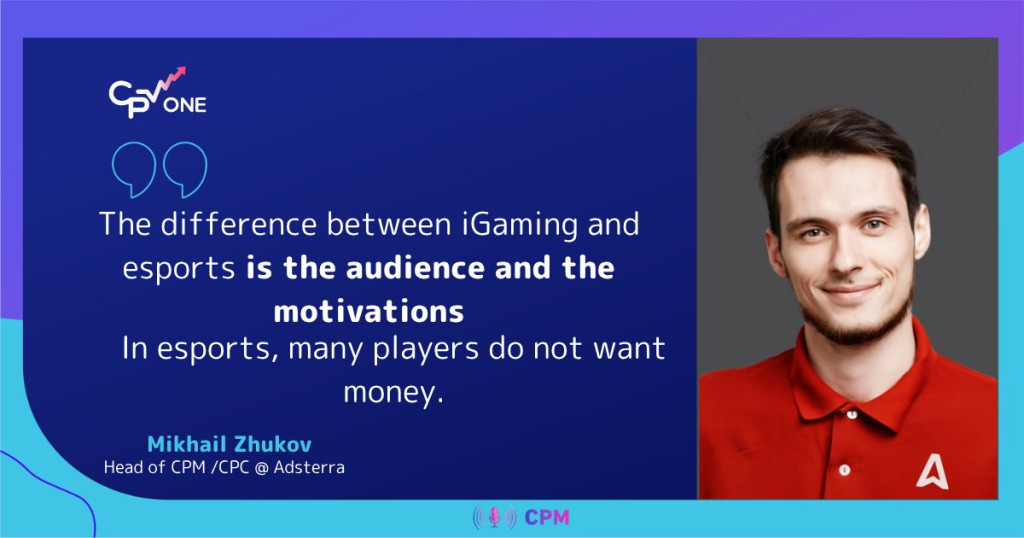
The motivations are different too. If you ask people in different parts of the world why they play iGaming, some say it is for relaxation, because they are tired from work. In other places people want to get rich, because they could accidentally win a jackpot. In esports, many players do not want money. They want the internal currency of the game, like in Counter-Strike or Dota.
The way you promote and interact with people is similar, because the core is the same, and so is the dopamine. But you have to change the message. In one case you say “here is a bonus of $100”, and in the other “here you can win some cool stuff for your character in the game”. It is the same thing in a different language.
Julia’s Take: This is true in any business. You need to know your audience and who you are addressing your offers to, before you can market them.
Q: Which GEOs are interesting in iGaming right now? Which ones look good on paper but are hard to make work, and which ones are less known?
Mikhail Zhukov: We have to keep in mind the culture and the level of income. Let me go through the continents.
In Latin America, it is for sure Brazil. Unfortunately it is highly restricted by iGaming legislation, but there are some gaps. At the time of recording they had just opened, about two weeks earlier, and a lot of people were coming to try to gain revenue. Then there are Argentina, Colombia, Peru and Mexico.
In North America there is the United States, where we can discuss which states allow iGaming and what type you can run. There is also Canada, where Ontario has different kinds of licenses from the rest of the country. Then there are Australia and New Zealand.
In Africa it is Nigeria, Egypt, Morocco and Ghana. In Europe it is Portugal, France, Germany, Bulgaria, Romania and Poland. You can also look at the Nordic countries, like Norway and Sweden, but they have huge restrictions.
One of the most interesting regions right now is Asia. It is a tricky one and it has to be explored, but it will be very surprising for people who find an offer and try themselves in the Asian market with Asian traffic. I am speaking about Indonesia, Vietnam, India, Pakistan, Malaysia, Korea and Japan.
The regulations there are not so strict. They try to keep everything in the right legal field, but at the moment they do not have enough power or money to make something really strong, like Brazil did or like we have in Europe. This is the main reason why we can make some great and interesting moves there.
Q: Do creatives have to be different for each region?
Mikhail Zhukov: Yes, for sure, because it is culture, and culture is directly connected with the interests of the people.
In Asia people really believe in luck. If you use lucky numbers and lucky colors in your creatives, like red, or even food, they really enjoy it, and it works well to involve people and make them interact.
Right after COVID we had discussions comparing funnels, prelanders and how people decide to go to a platform. It is completely different by region. Some creatives work only in Asia, like anime style and bright colors, and only if the internet connection is good. The same creatives do not work in Africa, in Northern Europe or in Eastern Europe.
Local languages are another big topic, and it is connected with AI. Five years ago it was funny to see how people started iGaming campaigns. Someone who does not speak the language would come to work with Bulgaria or Romania, and the messages had mistakes because they were translated with Google Translate and had the wrong meaning. Today there is no such problem. Translation and adaptation in creatives are really interesting now.
Julia: AI is helping a lot with creatives and landing pages.
Mikhail Zhukov: Yes. In some ways it makes us a little scared about our future, because with one click you have everything, even the strategy for how it works.
Julia’s Take: I agree with Mikhail on both points: AI saves a lot of time, and it is a bit scary how fast it moves. In Part 2 he goes further, with a story from Brazil about local football phrases that gave him one of his best CTRs.
Q: If someone does not know much about iGaming and has no experience, how can they get started?
Mikhail Zhukov: It is really simple today.
Five years ago, seven or eight years ago, you had to put together a lot of sources, research, speak with someone, and go to closed private forums to find information and a place to start.
Now it is much easier. You can go to AI and ask, “Help me with my education in iGaming.” But there is a big trap, because AI gives you a compilation of articles, and they may not match reality. It could be something very basic.
For people who want to start, first of all you need to find a really strong offer. To find it, do research, see the reviews, speak with people who already work in it, and ask for their experience. You can also go to Adsterra support and ask which GEOs or brands are really strong on our side. That will be information from our statistics, and the team will help you find a strong offer. You take that brand name, go to the affiliate programs and find the offer there.
Then you decide which type you will run, RevShare or CPA. For beginners it will be RevShare.
Third, you have to find a good tracker, because without tracking you will be like a blind kitty. You will receive tons of traffic, and if you do not separate it by placement zone, you will lose a lot of money. This is where optimization starts.
The big mistake I see is people trying to do everything at the same time.
For example, they go to a big brand, open an affiliate account, take the links for worldwide traffic for all GEOs, and run everything. The budget disappears in one or two hours, and there is no money and no result. Then they write to people saying it is not working.
You have to be a bit of a control freak. Use every tracking solution that is possible, be very accurate, and check what is going on every two or three hours. Blacklist the zones that do not work.
Adsterra has more than 40K direct publishers, which is an amazing number for the network, but it also means that some sources of traffic are not right for you. You need to feel it and touch it, with your hands and your eyes, because you have to see the stats.
The main point of all of this is optimization. Each network has its own tools, but most of them are similar.
With a CPA goal, for example, sources are excluded or blacklisted automatically from your campaign. With custom bids, you find sources that bring many conversions, leads, first deposits and redeposits, and you set a higher bid on them than the campaign average to buy more traffic from them.
Julia’s Take: Mikhail’s “blind kitty” line is the shortest case for ad tracking I have heard. You cannot blacklist a placement if you do not know which placement is behind the deposits. If you run Adsterra traffic with CPV Lab, there is a ready-made Adsterra traffic source, and our Adsterra integration guide shows how to import it and set up the postback. If postbacks are new to you, start with our postback URL tracking guide.
Q: Is RevShare really the best way to start, and not CPA? What about hybrid deals?
Mikhail Zhukov: Yes, and I will explain why.
If you go for CPA, it means you are really confident in your traffic source. You know the audience is an iGaming audience, and you will receive a steady number of conversions every day, so it will be profitable.
CPA is a model for people who already know how it works, and for people who are ready to lose some money along the way.
For people who are just starting, it is RevShare for sure. It helps you extend the lifetime of your campaign and the time you have for optimization. You are more flexible, you can analyze, and even if you stop the traffic you still get revenue, because the players are alive and they keep playing.
Julia: So it is like recurring income. You make money in the long run.
Mikhail Zhukov: Yes. Hybrid is also a really nice option, but again, only if you know everything about your audience and your traffic: where it comes from, why, and how much of it there is. RevShare is pretty good for beginners, because in any way you will receive your RevShare for the whole lifetime of your campaigns or of your activity in iGaming.
Julia’s Take: Quick definitions for anyone new to the terms. RevShare means you earn a share of the revenue the players you bring generate over time. CPA means a fixed payment for each action you deliver. Hybrid mixes the two.
Q: How do you decide if an offer is worth testing?
Mikhail Zhukov: It is a really good question, because if you search for offers right now you will find a lot of them.
The well-established ones have been in the market for five, seven or even more than ten years. Finding a new good offer is pretty easy. You can go to forums, you can Google it, or you can ask AI to compare what is in the market.
For example, if you want to work in Nigeria, ask who is on top in Nigeria and it will share a list of brands.
Then you can use Google tools to see how many people type that brand into Google search, and compare. You can also use a tool like Semrush to check the domain name, how often it appears and how much traffic goes to it.
With these checks you will see whether the brand is popular, and a popular brand has already done like 30% of your job. They built the brand awareness, so people know it, people believe in it and people use it. That means you can try to bring traffic to it.
Julia: So it should be a well-known brand.
Mikhail Zhukov: For a newcomer, yes, one of the well-known ones in the local market. But there are two strategies, and I will come to the second one in a moment. Once you have the offer, go to Adsterra support and say, “I have this offer, can you help me set up the campaign with a whitelist or blacklist?” The team will help you with sources. That is the first step of campaign setup in any ad network.
One more tip for people starting in iGaming.
Almost all affiliate platforms have affiliate managers. They help you with information and tips and show you how things look on their side.
For example, they can tell you “today we have really nice volumes for Nigeria”. But pay attention to how the affiliate manager behaves. If he is not responsive and answers only once a day, be careful. If you see something going wrong, just leave, because you will probably have problems with adjustments and payments too.
Julia’s take: I had an interesting talk about affiliate programs and affiliate managers with Stefan-Paul Muehlbauer, if you want to check it out. Stefan has worked with hundreds of affiliate managers, training them, so he knows these things.
If the communication is good, they approved your account, they are talkative and friendly, they try to help you and they stay in touch, that is a good sign. If they try to skip you and avoid speaking with you, leave them alone.
Now the second strategy.
Some media buyers do not go for popular targeting. Everyone knows that Nigeria or Ghana work very well, and that means high competition. So these buyers look for countries with a smaller audience but low competition, find a nice, well-established offer, and launch there. You receive less traffic and fewer conversions, but with RevShare the quality and the number of players works perfectly. They always try to find a country that is not common in iGaming, or a specific target like mobile Android or mobile iOS.
They also look for unusual sources. Maybe it is the local social blog of a guy who reviews food. The people who follow him could be a very suitable audience for iGaming, and it works. I have seen the revenue numbers of these buyers and they are pretty amazing.
Julia: So these are little gems that are hidden.
Mikhail Zhukov: Yes. It is not really a secret, but nobody pays much attention to tiny spots in targeting, and I think that is a mistake. You can catch a big whale there. We had a case in Nepal where we caught a whale who brought really big revenue for us. It was an amazing day, and nobody expected it.
CONCLUSION
Here is what I believe everybody should remember from my conversation with Mikhail.
The first thing is how much of his advice comes back to the audience. iGaming and esports use the same mechanics, but the words change: a $100 bonus for one audience, something cool for your character for the other.
The same goes for regions. Lucky colors work in Asia and not in Northern Europe. Knowing who you talk to comes before any tool or budget.
The second thing is how simple his beginner path is: a well-known offer, RevShare, a tracker and a GEO you have researched. The hard part is not doing everything at once, and that is where most budgets disappear.
Here’s what to take away from Part 1:
- iGaming is growing, and Mikhail finds it easier to enter today than e-commerce, VPN, utilities or Nutra.
- Esports and betting share the same mechanics, but esports audiences are younger (14 to 35) and have a lower LTV.
- Check culture, income level and local rules before you choose a GEO. Mikhail finds Asia the most interesting region right now.
- Creatives must match the local culture and language. AI makes translation and adaptation easy.
- Start with RevShare, a strong and well-known offer, and a tracker.
- Do not run worldwide traffic on one link. The budget can be gone in one or two hours.
- Pick an affiliate manager who answers fast. If they avoid you, leave.
- Small, low-competition spots can bring big players, even a whale.
In Part 2, Mikhail and I get into campaign setup and limits, why you should not blacklist a source too early, how much budget to start with and how long to wait, the metrics to watch, prelanders versus direct traffic, how to scale, where AI helps, what to know about regulations, and his top advice for beginners.
If you are testing a new GEO or offer, tracking tells you which placements bring deposits and which only burn budget. CPV Lab has a ready-made Adsterra traffic source, and the Adsterra integration guide shows how to set it up. If you prefer a cloud-hosted tracker, take a look at CPV One.
Start your 14-day free trial here!
Contact Mikhail Zhukov
If you work in iGaming or want to start, Mikhail is happy to talk. He said you can write to him with any question about iGaming or Adsterra’s other verticals, and that any case is experience he shares later in podcasts and panel discussions.
- LinkedIn Mikhail Zhukov
- Telegram: @ bellator1234
- Company website: Adsterra
More episodes from Champions of Performance Marketing:
- Josh Littler on creatives, tracking gaps and using AI
- Jane Ejim (ClickDealer) on scaling e-commerce campaigns
- Pierre Bertin (RollerAds) on push ads, smart tracking and affiliate wins
- Kyle Dana (Digistore24) on what separates successful affiliates (Part 1)
See the whole interview on YouTube or on Spotify.
[YouTube embed coming soon]
FAQ
What is the Champions of Performance Marketing podcast? Champions of Performance Marketing is a performance marketing and affiliate marketing podcast hosted by Julia Draghici, CEO of CPV Lab and CPV One. Each episode features an interview with an affiliate, media buyer, network or brand leader, and every interview is also published on the CPV Lab blog as a written Q&A.
Who is Mikhail Zhukov? Mikhail Zhukov is the head of the CPM/CPC department at Adsterra. He has worked at the ad network for 8 years and has focused mostly on iGaming for more than 6 of them.
What makes iGaming different from other affiliate verticals? According to Mikhail Zhukov, iGaming has a large audience and well-developed products. He finds it easier to enter today than e-commerce, VPN, utilities or Nutra, and says it can be more rewarding once you know your audience.
What is the difference between iGaming and esports for affiliates? The promotion mechanics are similar, because both rely on emotion and dopamine. Esports audiences are younger (14 to 35) and have a lower LTV, and many esports players want in-game currency rather than cash, so the message has to change.
Should beginners choose RevShare or CPA in iGaming? Mikhail recommends RevShare for beginners. It extends the lifetime of a campaign and the time you have to optimize, and you keep earning from players even if you stop the traffic. CPA fits people who already know their traffic source well.
How do I know if an iGaming offer is worth testing? Choose a well-known brand in the local market. Check how many people search for it on Google, check its domain traffic with a tool like Semrush, and watch how responsive the affiliate manager is. A brand that is already popular has done part of the awareness work for you.
How can I track Adsterra campaigns with CPV Lab? CPV Lab includes a ready-made Adsterra traffic source that you import and then set up with a postback to send conversions and optimize the traffic you get. See the CPV Lab Adsterra integration guide for the steps.

Author: Julia Draghici
Julia is the CEO of CPV Lab and CPV One ad trackers. She has 15+ years experience in the software industry, from development to management. For more than 8 years she is helping marketers get the best out of their marketing campaigns by using a performant ad tracker. Passionate about entrepreneurship, business and performance marketing, Julia loves helping people!