TL;DR: We have been in performance marketing for over 10 years – building a tracker, running campaigns, and talking to hundreds of media buyers about what breaks. Here is our honest take on the platforms worth considering in 2026 and 2027.
| Platform | Best for | Hosting | Starting price |
|---|---|---|---|
| CPV One | Affiliate Media buyers and brands running multi-channel campaigns | Cloud | From $67/mo |
| Voluum | High-volume buyers who need a full feature set and can absorb the price | Cloud | From $149/mo |
| RedTrack | Eccomerce brands mixing paid ads and affiliate traffic | Cloud | From $169/mo |
| BeMob | Affiliates starting out or running simpler campaigns | Cloud | Free / $49/mo |
| ClickFlare | Affiliates exploring a newer, UX friendly platform | Cloud | From $79/mo |
| ClickMagick | Solo affiliates and direct response marketers | Cloud | From $79/mo |
| CPV Lab | Media buyers who want full data control and no click limits | Self-hosted | From $57/mo |
| Binom | High-volume push/pop buyers who need raw redirect speed | Self-hosted | From $149/mo |
Before we get into the list – there are two different things people call “affiliate tracking.”
One is the software affiliate networks use to manage their affiliates, track commissions, and run their own affiliate programs (tools like Post Affiliate Pro, Tapfiliate, or Impact).
This article is about the other kind: the tools affiliate media buyers use to track their own campaigns – traffic sources, landing pages, creatives, offers, and conversion data – so they know exactly what is making money and what is not.
If you are an affiliate network looking to manage your affiliates, this list is not for you. If you are a media buyer or a brand running paid campaigns and affiliate offers, keep reading.
Choosing an affiliate ad tracker is not a minor decision. Your tracker sits at the center of everything – between your traffic source, your landing pages, your affiliate networks, and the algorithm of whatever ad platform you are running. If it misses a conversion, fires the wrong signal, or goes down during a live campaign, you lose money and data you cannot recover.
We build one of the trackers on this list. We will be upfront about that throughout this article. But we have also had users come to us from every other platform here, and we know exactly what broke for them. That experience is what this comparison is based on.
CPV One: Best for Affiliate Media buyers and brands running multi-channel campaigns
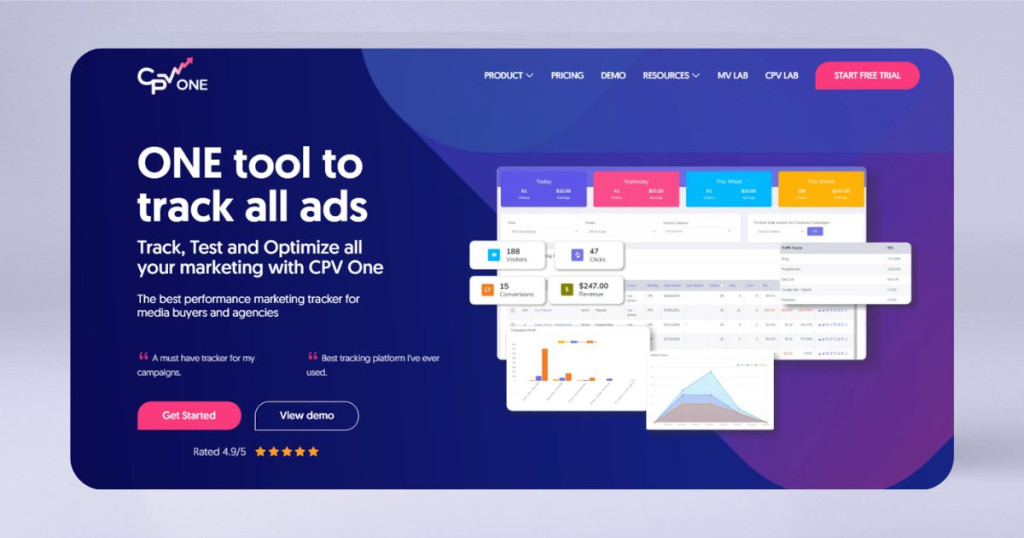
CPV One is a cloud-based affiliate ad tracker built for media buyers running campaigns across multiple traffic sources and affiliate networks simultaneously. It is the cloud version of CPV Lab, which has been in the market for over 10 years.
Best for: Affiliate media buyers, performance marketing teams, and DTC brands running Meta, Google, TikTok, Native, Snapchat, and push traffic together from one dashboard. Marketing agencies recommending a tracker to their brand clients will also find CPV One a strong fit.
Current features:
- Tracks campaigns across 200+ traffic sources and affiliate networks with pre-built integrations
- Full CAPI integrations with Meta, TikTok, Google Ads, Microsoft Ads, and Snapchat – conversion signals pass back to the platform so the algorithm optimizes correctly
- CPV Copilot (Beta): AI assistant that reviews your campaign performance and suggests next steps – free during beta
- AI Smart Rotations: Shifts traffic between landing pages or offers toward better performers based on conversions, revenue, or ROI – while keeping weaker variations live for continued testing
- AI Page Validation: Runs automatic checks when you save a campaign – looks for broken links, missing tracking code, offer format issues, click ID problems, and scans landing pages via VirusTotal for suspicious content
- MV Lab AI Assistant: Generates headline, CTA, and copy variations using your vertical and examples – keep, regenerate, or change tone per suggestion
- API v2: Built for AI tools and automation workflows
- MCP (coming soon): Connect AI assistants like Claude, ChatGPT, or Gemini to manage and analyze campaigns through natural language
- Make.com native integration: CPV Lab is available as a custom app in Make.com for workflow automation
- Unlimited campaigns on all plans – no caps on what you can test
- Multi-user access with granular role permissions – control exactly which landing pages and offers each team member can see and edit
- 30-day money-back guarantee (the only tracker on this list that offers one)
- CJ Affiliate and 2Performant API integration
- Google certified click tracker
- Cost sync via API for TikTok Ads, Google Ads, Microsoft Ads, Meta Ads, Outbrain, RevContent, Newsbreak and Taboola
- Partial revenue postbacks and second event postbacks for advanced traffic source optimization
- Campaign import from ClickMagick, Voluum or BeMob via API – no manual rebuild when switching
Cons:
- Advanced features like CAPI setup and custom attribution paths require configuration time upfront
- The interface has depth – new users sometimes need a session or two to familiarize with the platform

💡Our take: This is our tool, so take this with appropriate context. What we can say honestly is that the users who come to us from Voluum almost always mention two things: the pricing cliff when they needed CAPI or automation on a higher plan, and support experiences that were slow or costly. We built CPV One to avoid both. The 30-day money-back guarantee exists because we are confident in the product – and because we think it is the right way to treat people who are trusting you with their campaign data.
Voluum: Best for High-Volume Buyers Who Need Everything in One Place

Voluum has been around since 2013 (like CPV Lab) and is one of the most feature-complete affiliate trackers on the market. It covers media buying, affiliate tracking, and automation in one platform. It recently added MCP support, making it one of the first trackers to let you manage campaigns through AI assistants.
Best for: Experienced media buyers running serious volume who need advanced automation and can absorb the pricing.
Pros:
- Traffic Distribution AI automatically shifts traffic toward better-performing offers and landing pages
- Automizer connects directly to ad platforms so you can pause campaigns, adjust bids, and set rules from inside the tracker
- Anti-fraud kit detects and blocks invalid traffic and bot activity
- Strong reporting depth – 30+ metrics, scheduled reports, collaborative workspaces
- Established platform with over a decade of track record and a large user base
- Conversion API: Sends conversion signals back to major ad platforms for algorithm optimization
- Mobile app (iOS and Android), scheduled reports, and mobile notifications
- White-label reports for clients, auto-updating shared reports
Cons:
- Pricing is the most common complaint from real users. Features like Google Ads conversion passback require jumping from the entry plan at around €144/month to plans closer to €577/month. Multiple Trustpilot reviewers have called this out specifically
- No refunds. Users have reported being charged for renewals and refused refunds even when they had not used the platform. One reviewer described an unauthorized charge after a cancellation attempt
- Support has drawn complaints for being expensive to access – one Trustpilot reviewer was told setup help would cost $149
- Some users report support availability gaps depending on timezone
- Documentation has been described as outdated by multiple independent reviewers
- Cancellation can be complicated – at least one reviewer reports card details remaining in the system after multiple attempts to remove them

💡 Our take: Voluum earns its reputation as a powerful tool and is ahead of most trackers on MCP adoption. The issue is not the product – it is the pricing structure at scale and the support experience at lower tiers. We have migrated campaigns for users switching from Voluum to CPV One specifically because of the plan jump required to unlock CAPI and automation. If budget is not a constraint and you are running high volume, Voluum works. If you are scaling and cost per tracked event matters, run the numbers before committing. See how CPV One compares.
RedTrack: Best for Ecommerce Brands Mixing Paid and Affiliate Traffic
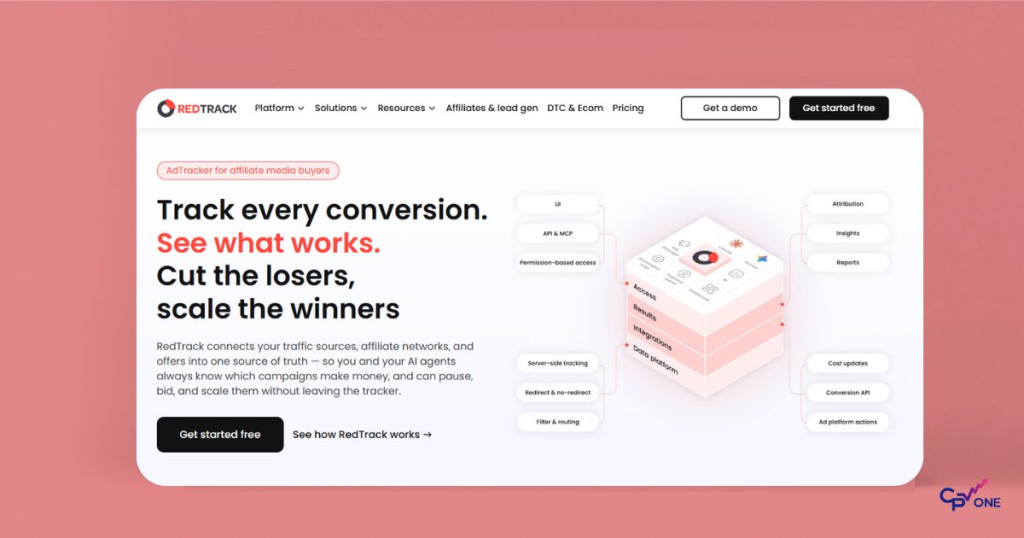
RedTrack positions itself at the intersection of paid advertising and affiliate marketing – tracking paid ads, affiliate partnerships, and influencer campaigns in one place. It recently added MCP and AI agent support, putting it among the more technically forward trackers on this list.
Best for: DTC brands and ecommerce businesses running paid traffic (Meta, Google, TikTok) alongside affiliate or influencer partnerships.
Current features:
- MCP: MCP available for AI agents to use the data.
- API: Full data access for pulling into other tools or AI workflows
- Server-side tracking with first-party data storage – handles ad blockers and tracking restrictions
- Conversion API: Sends matched conversions to Meta, Google, TikTok, Snapchat, and other platforms
- Cost and revenue sync every 5 minutes – ad spend tracked at campaign and ad level (depending on the plan)
- Automation rules running 24/7 – pause placements, adjust budgets, alert on ROI thresholds
- Partnership portal for affiliates, publishers, and influencers
- One-click Shopify integration, WooCommerce support
- 250+ integrations total including CRMs, call tracking, and BI tools
Cons:
- Real users have reported serious tracking accuracy issues. One Trustpilot reviewer found over 40% discrepancy between RedTrack data and actual sales. Another reported cost data off by 50%+ versus their traffic source. These are not minor – tracking accuracy is the core job
- Support response times have drawn consistent complaints. One user waited 30 hours for a live chat response during an active tracking problem
- Refund requests have reportedly been denied or handled poorly – at least one case escalated to a PayPal dispute, and a 2025 reviewer was offered a discounted upgrade instead of a refund and then received no further reply
- Base plan limits grouping to 3 levels – you need to upgrade for 5
- Only Last Click attribution on some plans – no First Click or blended model
- Ecommerce pricing scales with tracked revenue, which penalises growth
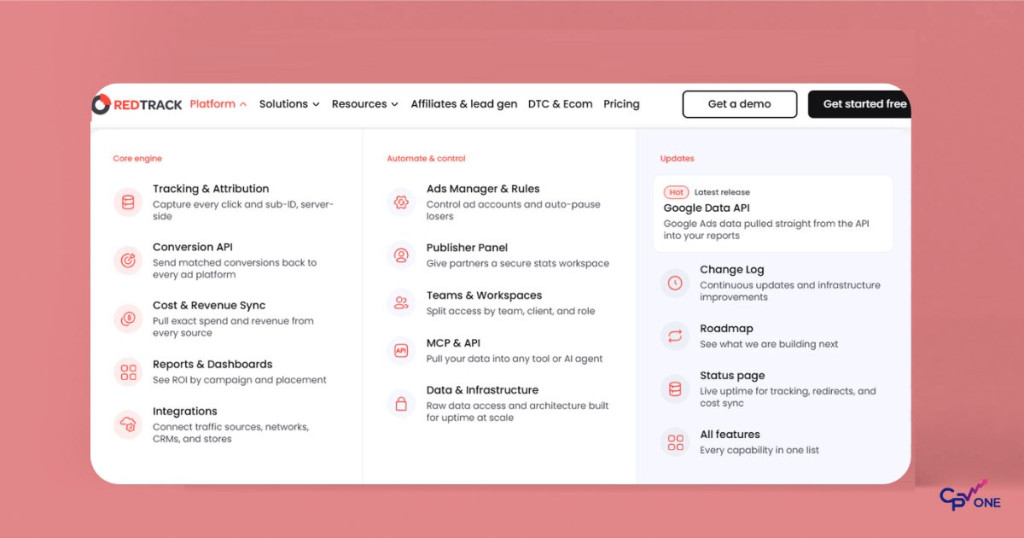
💡Our take: RedTrack has real strengths for the DTC and ecommerce use case. The tracking accuracy complaints from real users are the thing to take seriously before committing – if the data is not right, every optimization decision downstream is wrong. We cover the specific differences in detail here: CPV One vs RedTrack.
BeMob: Best for Affiliates Starting Out or Running Simpler Campaigns

BeMob is a cloud-based affiliate tracker with a free entry plan. It is popular among affiliates who are getting started or running straightforward campaign setups without complex multi-network or multi-team requirements.
Best for: Affiliates starting out, solo media buyers testing simple funnels, or anyone who wants a free entry point to learn tracking before committing to a paid platform.
Current features:
- Free plan with 100,000 events per month
- Server-side tracking with ~10ms redirects and auto-scaling
- Advanced rules, targeting, fraud protection, and bot blocking
- Automatic optimization based on performance data
- Cookieless tracking for Facebook, Google, and Bing
- Multi-funnel tracking
- API-integrated traffic sources – launch and stop campaigns without logging into your traffic source accounts
- Multi-language interface and support
- No AI features or MCP mentioned on current website
Cons:
- The limits on Professional ($49/month) are very restrictive: 50 campaigns, 50 offers, only 10 landing pages, 10 traffic sources, 10 affiliate networks. If you run any real volume or test broadly, you will hit these fast
- Custom tracking domains are not available until Business at $249/month. On Professional, you are using BeMob’s shared domain – which affects cloaking, ad platform trust scores, and tracking reliability
- Campaign limits: even on Business you are capped at 250 campaigns and 20 landing pages
- Add-on pricing is not transparent on the website – the page says features can be bought as add-ons but lists no prices, so your real cost may be higher than the plan price suggests
- Multi-user access is very limited – Professional allows 1 admin and 0 users. Business allows 2 admins and 1 user. Not built for team workflows
- No AI features or MCP integration currently

💡Our take:: BeMob is a reasonable starting point if you are new to tracking and want to learn without paying immediately. The moment you move to serious volume, test more than 10 landing pages, or need a custom tracking domain, the platform limits push you toward a $249/month plan. At that point the value comparison with CPV One shifts noticeably.
ClickFlare: Best for Affiliates exploring a newer UX friendly platform
ClickFlare was built by the team behind TheOptimizer and LanderLab – both well-regarded tools in the affiliate space. It launched in 2022 and has been building a following among affiliates who want a clean, modern interface.
Best for: Affiliate media buyers who want a modern tracker at a competitive price and are comfortable being an early adopter on a newer platform.
Current features:
- AI Copilot: Ask plain-English questions about your data – generate revenue graphs, get campaign restructure suggestions, surface underperforming offers
- AI Smart Traffic: Continuously adjusts traffic weights across landers, offers, and paths based on a chosen metric, in proportional or smart modes
- AI anomaly detection: Flags tracking failures in real time
- Tag Manager: Tracks clicks, forms, and custom conversions without developer code
- Conversion API: Sends matched conversions to Meta, Google, and TikTok
- Server-side tracking with redirects averaging under 50ms
- Multi-touch and multi-channel attribution models
- Real-time cost sync from ad platforms
- Ads Manager for pausing and scaling directly from the tracker
- 150+ traffic source templates, 165+ affiliate network templates
- 250+ integrations including CRMs, call tracking, and automation platforms
- Mobile app (iOS and Android)
- 14-day free trial
- API available, public docs at developers.clickflare.com
- No MCP integration currently listed
Cons:
- Shorter track record – launched 2022, so there is less documented history at high volume to judge long-term reliability
- Fewer independent user reviews available than established platforms
- MCP not yet available
- Pricing comparative with Voluum
- Feature set is still maturing compared to more established trackers
Our take: ClickFlare is worth watching, their AI features have moved fast lately. The honest limitation is the shorter track record. If you want to test it, the entry price makes it low-risk to run alongside your main tracker.
ClickMagick: Best for Solo Affiliates and Direct Response Marketers

ClickMagick has been around since 2014 and is popular with solo affiliates, funnel builders, and direct response marketers who want reliable click tracking with solid attribution modeling.
Best for: Solo affiliates, funnel builders, and small direct response operations running one or two traffic sources.
Current features:
- Cross-device tracking and multiple attribution models – Linear, Position-Based, Time-Decay
- Automated Insights: Daily email that analyzes ad performance, summarizes what changed and what needs attention (OpenAI integration listed, details limited)
- Click Shield fraud protection – blocks bots, competitors, and click abuse
- Tracks offline and phone conversions linked back to the original ad
- Integrates with 100+ affiliate networks via server-to-server tracking
- Ad cost sync, split testing, Smart Links
- Zapier integration for thousands of automation workflows
- API available at api.clickmagick.com
- Strong customer support reputation – live chat, onboarding calls, Zoom support
- No MCP integration currently listed
Cons:
- Plan limits hurt anyone managing more than one client or running multi-network workflows: Standard allows only 5 ad accounts per platform and 2 additional team members. Each additional site or store costs $40/month extra
- Starter plan capped at 10,000 tracked visitors – not built for real volume
- No custom tracking domain on lower plans – uses a shared domain that some ad blockers can flag
- No campaign import API from other trackers – migration is mostly manual
- AI feature set is limited compared to ClickFlare or CPV One
- No MCP integration currently

💡Our take: ClickMagick is a solid tool for what it is designed for – solo direct response buyers with focused traffic setups. Where it hits limits is when you are managing multiple clients, multiple ad accounts, or complex affiliate funnel setups. We have had users import their ClickMagick campaigns to CPV One specifically for the custom domain tracking and the CAPI integrations on standard plans. Full comparison here.
CPV Lab: Best for Media Buyers Who Want Full Control Over Their Data
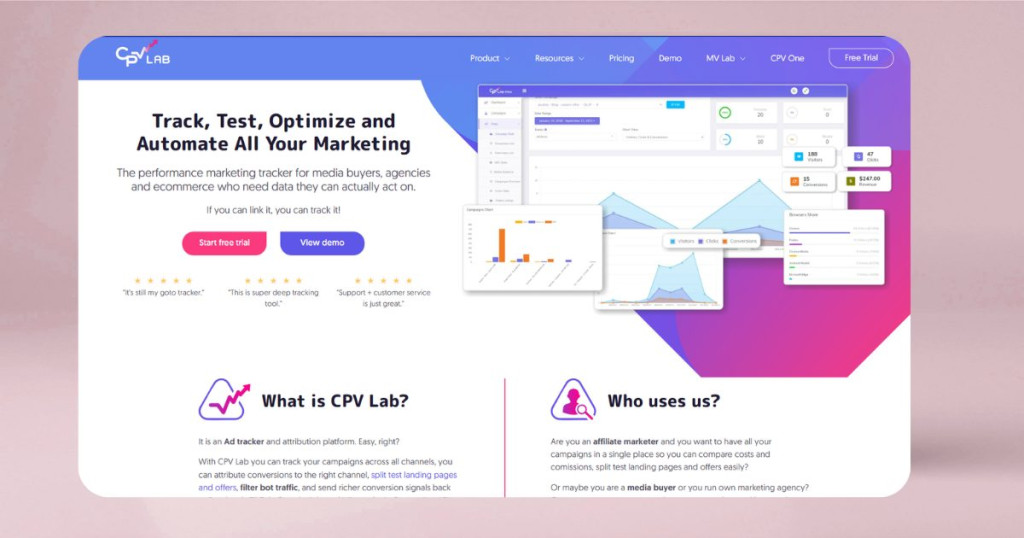
CPV Lab is the self-hosted version of our tracker. You install it on your own server, your data lives on your infrastructure, and you pay a flat monthly fee regardless of click volume. It has been in the market for over 10 years.
Best for: Experienced affiliate media buyers and performance marketing teams who run high click volumes, want zero dependency on a SaaS platform for their tracking data, and have the technical ability to manage a server.
Current features (as of 2026):
- Self-hosted – your data lives on your server, never ours
- No click limits, no event caps, no overage charges – cost stays flat as you scale
- CPV Copilot (Beta): AI assistant that reviews campaign performance and suggests next steps
- AI Smart Rotations: Traffic optimization toward better-performing landers and offers based on conversions, revenue, or ROI
- AI Page Validation: Automatic checks on save – broken links, tracking code, offer format, click ID issues, VirusTotal scan
- MV Lab AI Assistant: Generates headline, CTA, and copy variations for landing page testing
- API v2: Built for AI tools and automation
- MCP (coming soon): Connect AI assistants to manage and analyze campaigns through natural language
- Make.com native integration: Available as a custom app for workflow automation
- Full CAPI integrations with Meta, TikTok, Google, Microsoft Ads, and Snapchat
- 300+ pre-built integrations with traffic sources and affiliate networks
- Granular user access control – set which landing pages and offers each user can see and edit
- Cost sync via API for TikTok, Meta ads, Google Ads, Microsoft Ads, Outbrain, RevContent, Snapchat, Newsbreak and Taboola
- Partial revenue postbacks and second event postbacks
- Google certified click tracker
- 30 days money back guarantee
- Over 10 years in the market – battle-tested codebase
Cons:
- Requires a server – you manage hosting, updates, and infrastructure. Not suitable for anyone who wants a fully managed SaaS experience
- Initial setup takes longer than signing up for a cloud tool (usually between 15 -30min, depending on your skills)
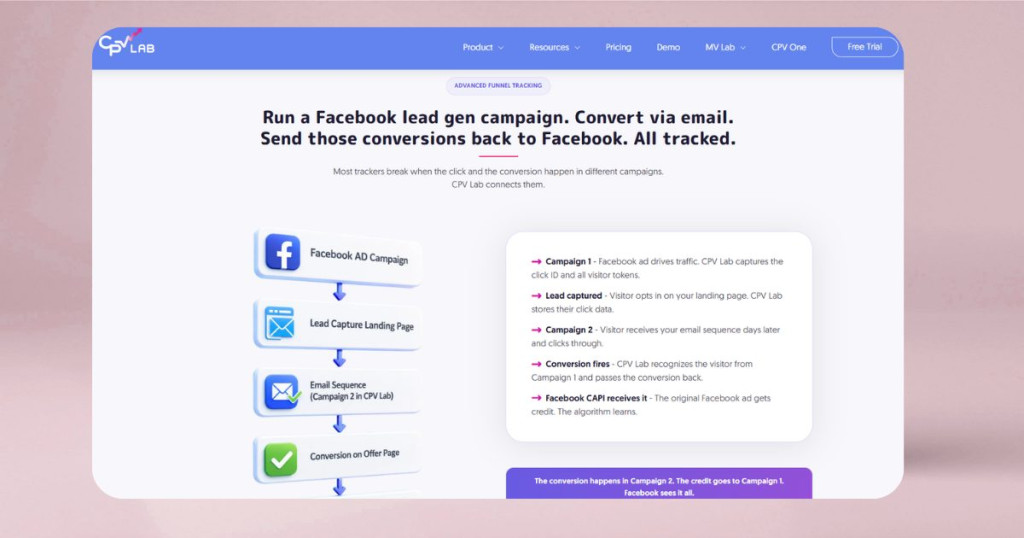
Our take: CPV Lab is the right choice if data ownership matters to you and you are comfortable with server management. The economics also change meaningfully at high volume – no overage fees means your tracking cost stays flat while cloud trackers start charging per event. If you want the same tracking engine without managing infrastructure, CPV One is the cloud version.
Binom: Best for High-Volume Push and Pop Buyers Who Need Raw Speed
Binom is a self-hosted tracker built for speed. It is designed for affiliates running large volumes of push and pop traffic where redirect latency directly affects conversion rates.
Best for: High-volume media buyers running push, pop, or native traffic at serious scale who need sub-millisecond redirects and are comfortable managing a Linux server.
Current features (as of 2026):
- Fast redirects – built for high-volume traffic types where every millisecond of latency matters
- Self-hosted on your own server – full data ownership, no per-click fees
- 30+ click metrics, 30 events and tokens
- Up to 5 grouping levels in reports, cross-campaign analysis
- Binom Protect (new): Built-in bot protection and cloaking module
- Integration with external cloaking services Magic Checker and Adspect
- Configurable incoming postback logic for custom conversion handling – ecommerce, subscriptions with rebills, complex funnels
- Mass editing of campaigns, landers, and offers
- Integrated landing page storage – edit landers directly in the tracker, reduces redirects
- Advanced API and Click API
- Automatic updates
- Facebook and Google Ads integrations in v1; coming soon to v2
- No AI features, no MCP
Cons:
- Requires a Linux server and technical setup – not beginner-friendly
- No AI features or automated optimization rules
- No annual discount – 12-month plans cost exactly 12x the monthly rate
- Cloud plan capped at 500,000 clicks per day
- Facebook and Google Ads integrations not yet available in v2
- CAPI integrations for Meta, Google, and TikTok are limited compared to CPV Lab or CPV One
- No MCP integration
Our take: Binom earns its reputation for speed and reliability on push and pop traffic. Where it is not the right fit is multi-channel campaigns that include Meta, Google, and TikTok – the CAPI integrations and automation features are not at the same level as CPV Lab or CPV One. If you are running exclusively pop and push at high volume and redirect speed is your top priority, Binom is worth evaluating. If your traffic mix includes social and search, a more full-featured tracker will serve you better.
How to Choose
You are an affiliate media buyer running multiple traffic sources: You need a tracker that handles postback tracking for affiliate networks AND passes conversion signals back to your ad platforms via CAPI. CPV One (cloud) or CPV Lab (self-hosted). Both cover Meta, Google, TikTok, Native, and push from one dashboard.
You are a DTC brand mixing paid ads and affiliate partnerships: You want to track your paid traffic and your affiliate network side by side. RedTrack was built for this use case. CPV One handles it too, with the added benefit of MV Lab for landing page testing and a more competitive entry price.
You are running push or pop traffic at high volume: Binom for raw redirect speed. CPV Lab if you also run other traffic sources and want one unified tracker.
You are just starting out in affiliate marketing: BeMob’s free plan is a reasonable place to learn. Know that the platform limits will push you to a higher plan quickly once you are testing seriously.
You are a solo affiliate running one or two traffic sources: ClickMagick or ClickFlare work well and cost less at this level. You are not paying for team features you do not need.
Data ownership is your priority above everything else: CPV Lab or Binom – both self-hosted, your data never leaves your server.
You want to test without committing: CPV One is the only platform on this list with a 30-day money-back guarantee. Start there, cancel if it does not work for you.
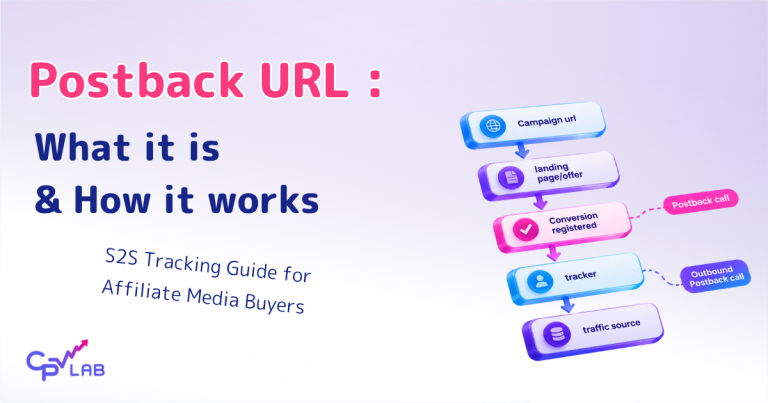
A Note on Postback URLs
Every tracker on this list uses postback URLs (server-to-server tracking) to pass conversion data between your affiliate network and your tracker. If you have never configured one, or you are running into issues with conversions not recording correctly, start here before you configure anything:
What Is a Postback URL and How Does It Work?
Frequently Asked Questions
What is the difference between an affiliate ad tracking platform and an affiliate tracking platform? An affiliate tracking platform (like Post Affiliate Pro, Tapfiliate, or Impact) is used by brands and affiliate networks to manage their own affiliate programs – tracking affiliate commissions and managing publisher relationships. An affiliate ad tracking platform is what media buyers use to track their own campaigns – monitoring traffic sources, landing pages, creatives, and conversions to find what is profitable and what is not. This article covers the second category.
What is the difference between a self-hosted and cloud-hosted tracker? A cloud-hosted tracker (CPV One, Voluum, RedTrack, BeMob, ClickFlare, ClickMagick) is managed by the vendor – you log in through a browser and they handle the infrastructure. A self-hosted tracker (CPV Lab, Binom) is installed on your own server. You manage updates and hosting, but your data stays under your control and you pay a flat fee regardless of click volume. The login for self-hosted is done also in the browser, on a domain you own.
Which affiliate ad tracker is best for Meta and TikTok ads? Any ad tracker with native CAPI (Conversions API) integration. CPV One, CPV Lab, Voluum, and RedTrack all support Meta CAPI and TikTok Events API. This matters because browser-based pixel tracking is unreliable after iOS privacy changes – server-side conversion signals are what actually feed the platform algorithm and drive optimization.
Can I switch trackers without losing my campaign data? You can export historical data from most platforms. Some migrations are easier than others – CPV One can import campaigns directly from ClickMagick, Bemob, Voluum via API key, which removes most of the manual rebuild work. For other platforms, our support team helps with migration setup.
How important is tracker redirect speed for my campaigns? It depends on your traffic type. For search and social traffic, a few milliseconds of redirect time is not meaningful. For pop and push traffic at high volume, where you are paying per impression and competing on conversion speed, latency matters more.
Is there a free affiliate tracker? BeMob offers a free plan with 100,000 events per month. For anything beyond basic testing, the plan limits push you toward paid plans quickly. Most platforms offer a free trial period instead of a permanent free tier.
Why does my affiliate network show more conversions than my tracker? Almost always a postback setup issue – either the click ID is not being passed correctly to the affiliate network, or the affiliate network is not firing the postback back to your tracker on conversion. Check your postback log in CPV One or CPV Lab first. Full explanation here: What Is a Postback URL?
Which ad trackers support MCP for AI assistant integration? Voluum and RedTrack have MCP live as of 2026. CPV One and CPV Lab have MCP coming soon. MCP lets you connect AI assistants like Claude, ChatGPT, or Gemini to your tracker and manage campaigns through natural language.
See CPV One in Action
Built for affiliate media buyers running multi-channel campaigns. 300+ integrations, full CAPI for Meta, TikTok, Google, Microsoft, and Snapchat, AI Smart Rotations, CPV Copilot, and a 30-day money-back guarantee.
Prefer self-hosted? Check out CPV Lab
Not sure where to start? Read our guide: How to Choose the Best Ad Tracker for Your Campaigns

Author: Julia Draghici
Julia is the CEO of CPV Lab and CPV One ad trackers. She has 15+ years experience in the software industry, from development to management. For more than 8 years she is helping marketers get the best out of their marketing campaigns by using a performant ad tracker. Passionate about entrepreneurship, business and performance marketing, Julia loves helping people!
We built CPV One and CPV Lab. This article is not fully neutral – we have an interest in you choosing our product. We have tried to be honest about where our tools are not the right fit and where other platforms do specific things better. If you want a head-to-head comparison between CPV One and any specific platform on this list: all comparisons.