TL;DR:
- Bogdan Arhip is a co-founder of Cuponescu.ro, a large coupon website in Romania. His team now runs four coupon and voucher websites in four markets: Romania, Bulgaria, Greece and Poland.
- Coupon affiliate marketing is free for the visitor. The store pays a commission through an affiliate network when someone buys, and the network tracks the sale.
- Organic search is their main source of traffic. Bogdan says that for keywords where they rank in the top three on Google, AI answers also quote them.
- The biggest challenge is fresh content, because offers expire every couple of days. They use AI with human review and the 80-20 rule: 20% of the brands bring 80% of the traffic.
- Coupon demand differs by country. For one marketplace, Bogdan found 14 coupon-code searches per 1,000 brand searches in Romania, and, as he remembers it, less than 1 in Bulgaria and Greece.
- His advice for a new affiliate business: just do it, launch even if it is rough, improve along the way, and give it at least a few months.
Coupon websites look simple. A visitor finds a code, buys something, and the site earns a commission. Running one that stays fresh, ranks on Google and grows into new countries is much harder.
Bogdan Arhip is one of the founders of Cuponescu.ro, a big coupon website in Romania, and the company behind it, VIARDIGITAL. In this episode of Champions of Performance Marketing, our performance marketing podcast, I wanted to understand how a coupon affiliate business thinks: how it makes money, how it picks offers and partners, and how it decides if a new market is worth it.
We cover how the model works, how Bogdan keeps coupons fresh, what changed with Google and AI search, how he picks new markets, how he tracks results, and what he would tell anyone who wants to start.
Let’s dive in.
Listen to the episode on our Spotify channel
Or watch it on CPV channel on Youtube
Q: Take me back. How did it all start, and what made you build a coupon website?
Bogdan Arhip: I always knew I wanted to start a business, but I was not sure which one. I worked in some corporations and some startups for a few years.
At some point I met my co-founder in one of the companies, and we were debating what we could start. We found coupons. We thought it was an interesting business model, especially the affiliate marketing model, and we wanted to try it. We always believed it would be successful, and we invested time, effort and money in it. At some point it paid off.
Julia: So you started with a business mindset, not as a side business. Many affiliates start on the side.
Bogdan Arhip: Yes, because we both wanted something to focus on. If you do it as a side business, it might take a very long time to actually grow it. You need to be 100% there with your time, not just your dedication, because time is what matters the most. How much time you give it is the thing. If you believe in an idea, you should put your time there.
Q: Why coupons specifically? There are many affiliate models.
Bogdan Arhip: We were exposed to some similar businesses, we evaluated them, and we saw how they worked. It was a successful model, and we wanted to give it a go. At the same time, we saw that many websites in the industry were taking advantage of this type of traffic without the right quality. They did not provide fresh content or updated vouchers.
It is always frustrating when you go on a coupon website and click, they set the cookie for you, but they do not give you a coupon that works. We wanted to change this mentality in the coupon business.
Obviously I consume coupons myself.
Q: How does coupon affiliate marketing work? Someone finds a code on your site and buys from a store. How do you get paid?
Bogdan Arhip: For the website visitor it is always free. We get paid by the store that makes the sale, and we get paid through affiliate platforms. An affiliate platform is a marketplace where publishers like us, coupon sites and other websites that promote brands, meet the brands that want to be advertised. In our business these brands are called advertisers, and we are the publishers.
The platforms put up all the offers from the advertisers, we promote them, and the platforms also do the tracking of the sales. In the platform we can see the clicks, the visitors and the conversions. We get paid when a visitor purchases by using our code.
Q: Which affiliate networks do you use, and are your coupons mostly e-commerce?
Bogdan Arhip: It depends on the country. In Romania we work with 2Performant, which is probably the biggest in Romania. If you want to expand internationally, you need to go to Commission Junction, Tradedoubler or Awin, which are present in several countries in the CEE region. And yes, our coupons are 100% e-commerce.
Q: Do you work directly with brands as well, or only with affiliate networks? Which is better for you?
Bogdan Arhip: We are getting there. We are newly born, now in the second year. So far we focused on expanding with the help of affiliate networks. Now e-commerce stores are coming to us and want to be listed, and with some of them we work directly, if they do not work with an affiliate network.
Both have pluses and minuses, but for efficiency I would say affiliate network, because you have a lot of brands in one place and the tracking is there. You can be up and running in a couple of hours. Working directly with a brand takes more effort. But if it is the right brand, one that consumers ask for and that is not on an affiliate network, then it can make sense.
This is part of the strategy for the next period. When we are recognized as an important coupon player in the market, we get requests from stores that are not on affiliate networks and want to be promoted.
Julia: It is nice to be recognized by brands and to have them come to you.
Bogdan Arhip: It is a good feeling, and a sign that we are making something good. The industry feeling is normally that a coupon is not that reliable. Now that brands are coming to us, it is a sign that we are making something valuable and that they trust us.
Julia’s Take: If you want to hear the network side of this relationship, listen to my interview with Parul Bhargava on how vCommission became India’s top affiliate network.
Q: What does the day-to-day work look like? Codes expire and campaigns change. How do you keep content accurate?
Bogdan Arhip: We have a lot of help from the AI revolution, I need to recognize that. We do it AI-based, with human review. AI helps us a lot with localization and with work that a few years ago would have taken weeks. Now you can do it in a couple of hours.
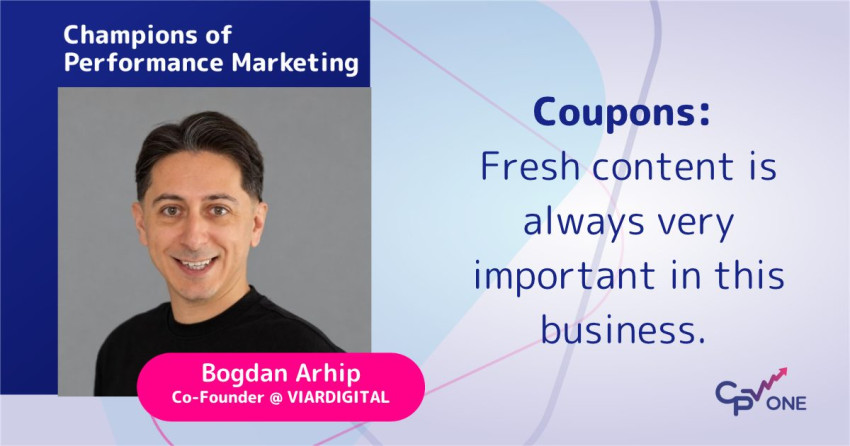
Fresh content is always very important in this business, because offers expire every couple of days, and all the big stores want fresh coupons and fresh offers. We work with the affiliate networks to update as much as we can automatically. When that is not possible, we do a manual review, especially for the big players, where we know the volume of searches and the number of interested customers is high.
We have some special brands where we pay special attention, the ones that bring the most traffic. Every business is like this.We follow the 80-20 rule: 20% of the brands will bring 80% of the interest or traffic.
If you want to be 100% correct and updated all the time, it will never be possible, because there are so many websites and so many offers. We make sure we offer the right quality for the majority of our customers.
Q: What is the biggest challenge in this business that people do not see from the outside?
Bogdan Arhip: Having fresh content. It still takes a lot of our time, and we are thinking about how to optimize it, but it is not always possible.
The second challenge is always optimizing for organic search, because it is our main source of traffic. If you have good content but nobody finds you, it is irrelevant.
Then there is being present in the media, going to events and talking to many people, so that brands trust your brand. These are the key points we work on every day.
Julia’s Take: We met at an event ourselves, and I am really happy we did. Bogdan’s point about events is a good reminder that relationships still start with people.
Q: Did Google updates and AI search change how people search? Did that hurt your business, and how do you get mentioned in AI answers?
Bogdan Arhip: Until now it did not impact us negatively. We have been growing since we started two years ago. We have been in more of a challenger role, not the leader, so I cannot say from the position of a leader whether they were more impacted. For us it actually helped a lot, because AI started quoting us.
If you rank well organically, it’s natural that AI will also quote you. It is not a 100% rule, but in our case it worked. For all the keywords where we were in the top three organically, AI would also quote and mention us.
Julia: How do you attract this visitor and grow organic traffic?
Bogdan Arhip: It is the same SEO optimization. It is content and also technical optimization. Your website needs to be fast and in line with what Google requires. There are certain technical SEO points I will not go into, but any SEO expert knows how to help a website do that. That is the base.
Then you need to keep feeding it with the right content. If you have a good base but no fresh content, it is no use. These two are the key to ranking in the top three for all the keywords you target.
Julia’s Take: I told Bogdan this is a very good skill to have. If you want to go deeper on how AI answers choose their sources, listen to my episode with Daniel Stanica on AI search visibility and what still works in 2026.
Q: How does AI help you run the business?
Bogdan Arhip: In content, obviously, and in making sure all the details are in line. We pick up the offers and the product feed from the affiliate networks, and we need to transform that content, and the campaigns the brands make, into the format we want on our website.
If you set rules for AI, it can follow them quite well. We set some important ground rules, and we have seen great results.
The more precise you are with what you ask from AI, the better results it gives. Do not let it interpret, and do not be neutral. Say exactly how you want your content to be, and AI will help you greatly.
I will give it the rules. Say “this is how you need to play”. Do not let it decide for you. In coupons, the way the website looks and the content structure need to be in the same format, so it is easy for customers to follow and read. That is how we did it with AI.
Q: Can a coupon site survive on SEO alone in 2026, or is it too risky?
Bogdan Arhip: It is challenging, but I think they can still survive.
Especially because the CSS partners (comparison shopping service partners) are taking the most important part of the advertising area in all the markets. We have seen a decrease on the coupons where CSS partners are live, but that does not exclude the business. It only decreases it a bit.
That is why part of our strategy was to expand to several countries, so we are not dependent on one single market. If something changes in one market and your revenue decreases, you will not be as affected as if you had just one.
We want to expand to maybe one or two additional markets, maybe early next year, for risk management, so we do not have all the eggs in one basket.
Q: You are now in four markets. How did you expand, and did you use the same playbook in each one?
Bogdan Arhip: We started in Romania. Then, because of instinct and opportunity, we expanded to Bulgaria, because one of the affiliate platforms we work with invited us to an event there.
That is also how we started going to events. We wanted to give it a go, and it opened our eyes. We saw what was successful in Romania and thought: why should we not apply the same logic to countries in the same geographical region? It should work. And we were right, it is working in Bulgaria too.
Then the next step was Greece, and now it is Poland. So we are in four markets, and they are all growing organically. We are doing exactly the same steps as in Romania. We are not reinventing anything.
We tested a lot in the first year. We had another website, not only Cuponescu, that we tested a lot. After a year we realized what was working and how, and we applied it to Cuponescu. In the second year we expanded and applied all this knowledge to the other countries.
It was a bit painful in the first year. You do not always get results, especially with organic and SEO. You need to wait a month, two or three, to know if you did the right job. In paid, you start a campaign and in a day or two you already know the outcome.
In organic you sometimes need to wait even months to actually understand if you did the proper foundation. For us it took almost a year to understand how it all works.
You need a lot of patience, and maybe some money put aside, so you can invest in the business while it is not generating for you.
Q: Do people in these countries use coupons the same way? How did you pick the region?
Bogdan Arhip: That was our initial assumption. But we have done some testing and analysis lately, and we have seen a different appetite for coupons from one market to another.
Some big players are present in all the markets, so there is brand awareness for them everywhere. Still, we saw a higher appetite for coupons in Romania than in Bulgaria or Greece.
Even some brands that were much better known in Poland than in Romania had more coupon interest in Romania. That does not mean those markets are not interesting, because they are growing too. It means they are at a different level of development when it comes to the coupon business.
Julia: Do you have some numbers or examples?
Bogdan Arhip: I can think of one. It was the interest in a marketplace like Trendyol between Romania and Bulgaria. For each 1,000 searches for the brand in Romania, you have 14 searches for coupon codes for that brand. In Bulgaria and Greece, for the same brand, from 1,000 brand searches it was, I think, less than one coupon search.
We thought the brand is also known in those countries. But the number of brand searches compared to the total population is actually higher in Greece. So Greece has more brand awareness than Romania, but still fewer coupon-code searches.
We decided to go to those countries anyway and we did the anlayze afterwards, that is true. But it does not mean there is no opportunity, because those markets are growing. Some big brands now rely on coupon codes, especially in more difficult economic times. People are searching for discount codes, so they are becoming more and more popular.
Julia’s Take: Look at the method behind the example. Bogdan compared two numbers for the same brand: searches for the brand, and searches for a coupon code for that brand. That shows how much of the brand’s interest turns into coupon demand in each country.
Q: Have you researched a market that looked attractive at first and turned out to be less interesting? How do you choose now?
Bogdan Arhip: Not yet. But I must be honest, in the beginning we wanted to test a few markets, just do it. Go there and do a bit of work. It is not that complicated to launch. It is online, and it just takes a bit of our time.
Now we want to do it more strategically. We look at the e-commerce value of the market and how many coupon players are there. We look at whether people are attracted to coupons or are not very aware of them.
We are already in the process of evaluating the next one or two markets. In this process it helps a lot to go to industry events, because we talk with people and ask them, besides the actual numbers, how e-commerce is going in a specific country.
Then we evaluate with what we’ve seen online. You can’t always just rely on what you find online. And you cannot rely only on what you hear at conferences either, because many times the numbers are highlighted or too big to be true.
Q: Does a new market need an affiliate network? How do you choose the next market, and do you stay with the same networks?
Bogdan Arhip: You definitely need an affiliate network. It makes expanding and tracking so much easier, especially when you want to stay low on resources and do not want people on the ground.
If you had a team there, you could go directly. But if you want to expand quickly, you need an affiliate network. That is one of the key points when evaluating a new market, and then which companies are listed on that network.
I will give you a hint about the next market: we are looking at the region. It makes sense to expand to one or two more countries in the region.
We are looking at the e-commerce value of those markets and how many coupon players are there. We are also in discussion with affiliate networks about what offers they can provide if we launch there.
We want to lead with offers from the affiliate networks that will help us grow organically, because if you have good offers and good coupons, people start searching for you.
Julia: Will you work with the same networks, like CJ, Awin and Tradedoubler, or search for new ones?
Bogdan Arhip: The first step, and how I would recommend other people to do it, is to work with your established partners, because it is the easiest way. If there is a new platform in that specific country, like 2Performant is specific to Romania, then also work with the new network. But it is very helpful to have a partnership from day one, so you can start tracking.
Julia: Do you have an account manager at these networks, or is it a self-serve platform?
Bogdan Arhip: Usually the more successful platforms have an account manager who takes care of you and works with you to develop the business. You help them develop some of the advertisers they work with.
They have some interest in you promoting specific advertisers, but it also helps us, because we get good deals and good coupons. In the end, if the customer also gets a better price, it is a win-win for everyone involved.
Q: How do you track results across all your networks? Which metrics do you check, and how do you handle attribution?
Bogdan Arhip: It would be nice to have a solution that consolidates all of them. Right now we track the networks individually. We look at specific conversion numbers, and they can differ from one network to another, because some networks focus on fashion and beauty and others on other industries. We always want to compare apples with apples.
Clicks are also important. If they decrease dramatically, there is a problem. If you get loads of clicks and no conversions, you can also have a problem. We have some industry standards for conversion, and this is what we look at, because we are paid on commission, so conversions are the heart of our business.
When it decreases dramatically, we start looking and we talk with the affiliate networks to understand what is happening. It is not bad if it increases dramatically. Nobody complains about that. So the metrics we look at are the volume of clicks and the number of conversions.
On landing pages, we tested a few formats in the first year. Now we believe we have reached a format that is suitable for the conversions we want, within the industry standards.
That does not mean we can go to sleep and leave it like that. We have focused more on expanding to new markets, so right now we rely on one format that we know converts well.
For attribution, I know some affiliate partners are more careful about it. We look at the bigger picture. When we see big differences, we look in Search Console to see where the organic traffic comes from and check whether it is in sync with what we see in the affiliate platform. If the differences are small, we do not track them.
Julia’s Take: This is where I told Bogdan we have to talk. That is why we built CPV Lab and CPV One: to help media buyers and publishers get a centralized view across all networks and traffic sources, and make real decisions, not simply celebrate commissions. Tracking comes up often on Champions of Performance Marketing. If you work with 2Performant,CJ Affiliate or any other network, CPV One has integrations with all of them. Here are some pages for 2Performant and CJ Affiliate, and you can see the full list on the CPV One integrations page.
Q: Many affiliates now mix SEO with paid ads. Have you considered that for a coupon site?
Bogdan Arhip: We do it, but as an exception, and with brands where we have a direct agreement. We do it in a specific way, as it should be for a coupon website. We do not see it as part of our main business, so we are not developing it further, but I think it is valuable and good to test with specific brands where there is an agreement.
Yes, we run ads on the brand name, and that is why we need an agreement. We focus mainly on Google search when we have this type of agreement.
Q: Do your four sites have different names and domains? Which market works best?
Bogdan Arhip: We try to adapt to each market. We started with Cuponescu in Romania, which is difficult to translate into English or another language, because you need to be local to understand the flavor of the word.
In Bulgarian we chose Cuponovo. In Greek we chose Kuponakis, which is the funniest one, and all my friends like it. In Poland we chose Rabatarnia. “Rabat” means discount, so we connected it with discount or code, and then extended the name a bit to make it similar to Cuponescu in Romanian.
Julia: Which market is going best? Not Romania, since that is where you spent the most time.
Bogdan Arhip: In terms of traffic, Greece. In terms of revenue, surprisingly Bulgaria. You would not think of that, right? It does have some limitations, so I think the potential is much higher for a market like Poland. But we are nearly at the beginning there, so we are still the challenger. Our strategy is that maybe next year we are in the top three, like we are in Romania. In Romania we are already an established name, and companies come to us to be listed. In Poland we are barely scratching the surface of the coupon market. Probably not many people have heard of us, but we are making the initial groundwork for that to happen next year.
Q: Are you considering other models beyond coupons? And how do you see the business changing with AI?
Bogdan Arhip: Right now we focus on coupons, because we want to develop this business. But we are a startup, and if a fresh idea comes, we are open to testing it. I was at a conference today and one idea came: maybe we could look into influencer marketing. If you run a coupon website, there is quite a big interest on social media. In Romania we already have an account with a considerable number of followers, so we could test some influencer platforms with promoting products. It is just an idea that came today, to show that we are open to testing new ideas. But the main business is the one we have seen working.
On AI, we do not know. There is always a risk. But I am positive about it. There was a hype when the internet started, and there is a hype with every big change. I am a positive person. I believe it will make things faster and easier, and we, the affiliate partners who promote, will find our place in the industry. The tracking will still happen somehow.
Q: If someone wants to start an affiliate business today, what is your top advice?
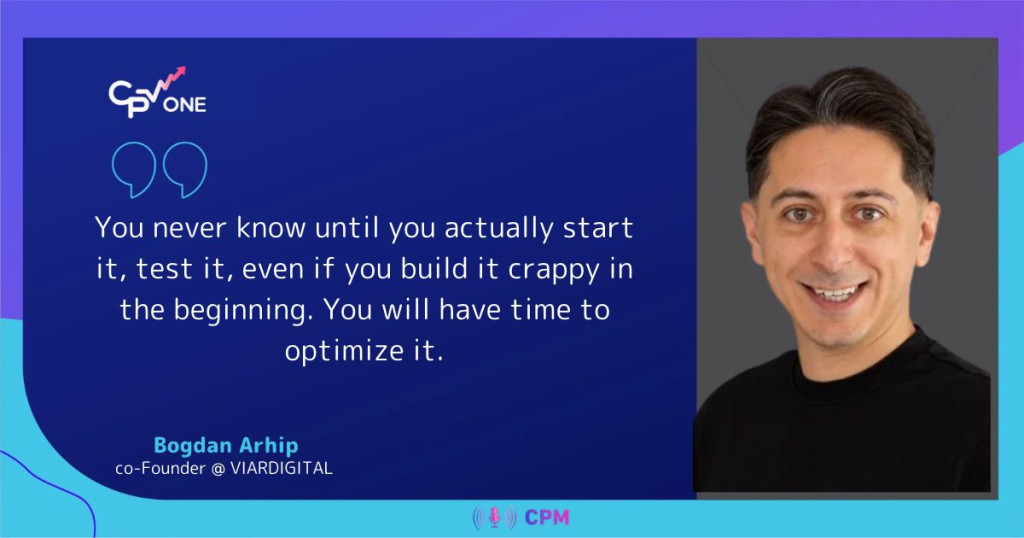
Bogdan Arhip: Just do it. Like the Nike slogan. If you think about it too much, you start thinking about all the roadblocks, “I should not do it because of that” or “this will not work”.
You never know until you actually start it, test it, even if you build it crappy in the beginning. You will have time to optimize it. If you believe in an idea, build it as best as you can. Do not overthink it, and do not spend too much time on it. Launch it, and improve it along the way.
Do it step by step. Especially now with AI, things are much easier to launch, because there are new ideas all the time.
If you do not do it when you have the idea, maybe in six months some other people across the globe have already started the same business.
And if you start a business, give it a real chance for a few months at least. You cannot expect a business to produce results after a month or two. If it is your idea, believe in it, and run with it until it provides results. Test, analyze, test, analyze, until you find the combination that works for you.
Kind of a conclusion
Two things stayed with me after this conversation with Bogdan.
The first is patience, together with testing. It took his team almost a year to understand how organic traffic works for them, and organic results can take months to show. Yet his advice is to start fast and improve later.
Those two ideas fit together: launch early, then give the work time.
The second is trust. A coupon only helps if it works, and that is the gap Bogdan saw in the market. Fresh offers, human review of the big brands, and now stores that come to them to be listed, all come from that one idea.
Here’s what to take away from this interview:
- Start an affiliate business as a real business. Bogdan says a side project can take a very long time to grow.
- A coupon site is free for visitors. The store pays a commission through an affiliate network when a visitor buys.
- An affiliate network gets you running in a couple of hours. Direct brand deals add exclusivity once you are known.
- Fresh working coupons are the main daily work. Follow the 80-20 rule and review the big brands by hand.
- Rank in the top three for your keywords. In Bogdan’s experience, AI answers then quote you too.
- Organic traffic needs patience, and some money put aside while it is not generating.
- Coupon demand differs by country. Compare brand searches with coupon-code searches before you pick a market.
- Use online data and industry events together, because you cannot rely on only one of them.
- A new market needs an affiliate network, and it helps to start with the partners you already know.
- Just do it. Launch, test, analyze, and improve.
- Whether you run coupon sites or paid campaigns, the same rule applies: know which source and which page actually bring the sale. CPV Lab and CPV One give you a centralized view of your networks and traffic sources, so you can compare results in one place. (hopefully Bogdan will start using CPV Lab soon and share his experience for everyone to see how much time you can get back)
Contact Bogdan Arhip
If you want to start a coupon or voucher website, or you have questions about how Cuponescu grew, Bogdan is happy to answer. He said you can write to him through the company website, where you will find an email address, and that you can also WhatsApp him on the phone number listed there.
- Company website: VIARDIGITAL
- Cuponescu (Romania): Cuponescu.ro
- LinkedIn: Bogdan Arhip
More episodes from Champions of Performance Marketing:
- Jane Ejim (ClickDealer) on scaling e-commerce campaigns
- Influencer marketing vs affiliate marketing: tracking performance and scaling e-commerce
- Kyle Dana (Digistore24) on what separates successful affiliates (Part 1)
See the whole interview on YouTube or on Spotify.
FAQ
What is the Champions of Performance Marketing podcast? Champions of Performance Marketing is a performance marketing and affiliate marketing podcast hosted by Julia Draghici, CEO of CPV Lab and CPV One. Each episode features an interview with an affiliate, media buyer, network or brand leader, and every interview is also published on the CPV Lab blog as a written Q&A.
Who is Bogdan Arhip? Bogdan Arhip is one of the founders of Cuponescu.ro, a large coupon website in Romania, and of the company VIARDIGITAL. His team now runs four coupon and voucher websites in Romania, Bulgaria, Greece and Poland.
How does a coupon website make money? Visitors use the site for free. When a visitor buys from a store using a code from the site, the store pays a commission through an affiliate network, and the network tracks the sale. Bogdan Arhip says conversions are the heart of the business, because the site is paid on commission.
Should a coupon website use affiliate networks or work directly with brands? Bogdan recommends affiliate networks for efficiency, because many brands are in one place, tracking is included and you can start in a couple of hours. Direct deals take more effort but can give exclusivity, and brands start coming to you once your site is recognized in the market.
How do you choose a new market for a coupon website? Bogdan looks at the e-commerce value of the country, the number of coupon players, the offers available on affiliate networks, and how much people search for coupon codes compared with brand names. He also talks to people at industry events, because he does not rely only on online data. A new market must have an affiliate network.
How can a coupon site rank in Google and get quoted by AI? Bogdan says it is the same SEO work: a fast, technically sound website and fresh, well-structured content. In his experience, for keywords where Cuponescu ranks in the top three on Google, AI answers also quote and mention it, although he says this is not a 100% rule.
How can I track results across several affiliate networks? Bogdan tracks each network on its own today and says one consolidated view would be useful. CPV One has integration pages for 2Performant and CJ Affiliate so you can follow clicks and conversions in one tracker.

Author: Julia Draghici
Julia is the CEO of CPV Lab and CPV One ad trackers. She has 15+ years experience in the software industry, from development to management. For more than 8 years she is helping marketers get the best out of their marketing campaigns by using a performant ad tracker. Passionate about entrepreneurship, business and performance marketing, Julia loves helping people!