Meta remains the go-to platform for performance marketers, and for good reason. The combination of massive reach, sophisticated optimization algorithms, and relatively low entry costs makes Meta ads the ideal starting point for media buyers at any level.
Yes, iOS 14.5 changed things. Attribution got messier, and tracking accuracy dropped.
But the fundamentals of profitable Meta advertising haven’t changed, they’ve just become more important. This guide covers what’s actually working right now, based on insights from media buyers who run profitable campaigns every day.
Why Meta Is the Best Starting Point
If you’re new to media buying, Meta offers something no other platform can match: the ability to learn without burning through your budget.
You can test creatives, audiences, and offers with minimal daily spend while the algorithm does the heavy lifting of finding people likely to convert (Andromeda may have changed things a little bit though).
The low barrier to entry is a real advantage. Even spending just $20-50 a day, you can start building data and understanding what works for your offers. This accessibility, combined with Meta’s sophisticated targeting capabilities, makes it the ideal training ground before expanding to other platforms.
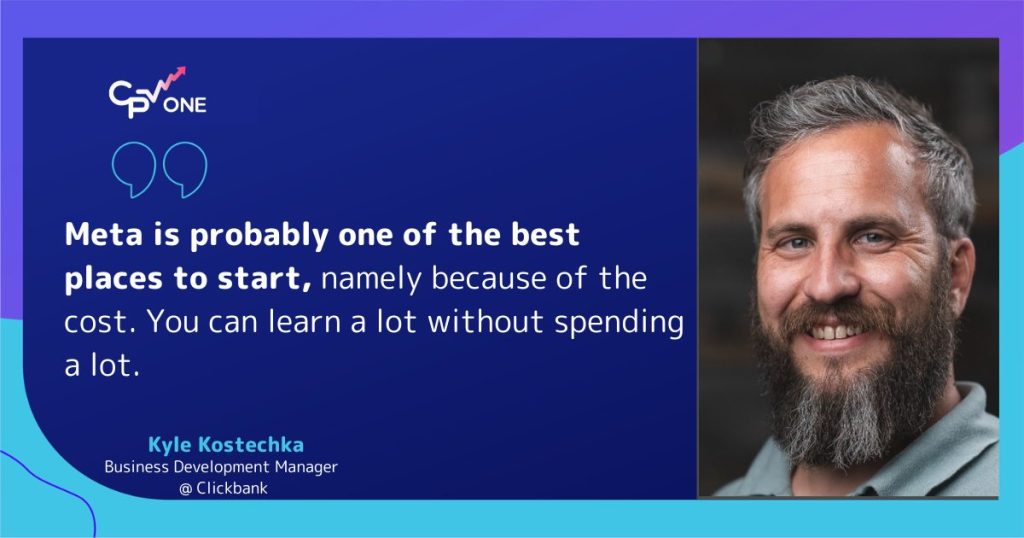
As Kyle Kostechka (former from ClickBank) notes in our Champions of Performance Marketing interview: “Meta is probably one of the best places to start, namely because of the cost. You can learn a lot without spending a lot.”
The algorithm’s optimization is Meta’s secret weapon.
Unlike traditional media buying where you’re essentially guessing which placements will work, Meta’s machine learning actively seeks out users most likely to take your desired action. Feed it accurate conversion data, and it gets smarter over time.
The Scaling Strategy: From Max Conversions to Target ROAS
One of the most effective scaling methods comes from Robert Odaila, who runs sweepstakes campaigns across Facebook and YouTube with his partner Emil (BlackEmil). His approach to scaling accounts is systematic and proven.
“We always start an account with a low budget like $50 for maximize conversions,” Robert explains. “After that, we scale it to $150 per account, and after a few days of getting more than 50 conversions, we set up Target ROAS campaigns. The condition is to have at least 50 conversions, at least 50 to have the pixel fed up. After that, you can start with Target ROAS campaigns and scale them to the moon.”
This progression: Max Conversions → scale budget → Target ROAS after 50 conversions, gives the algorithm enough data to optimize effectively before switching to return-focused bidding.
📹 VIDEO: Watch Robert explain his scaling strategy for sweepstakes campaigns
The Testing Mindset
The single biggest differentiator between profitable media buyers and everyone else?
Testing frequency.
Not testing once and hoping for the best, continuous, systematic testing of every element in your funnel.
Elnur Aliev from Beard Media has been running VSL offers across Facebook, Google, TikTok, and native for eight years. His approach is refreshingly simple: test relentlessly. Many beginners make the mistake of picking one offer, seeing it doesn’t convert, and giving up.
But that’s not how successful media buyers operate.
You need to test enough offers, enough creatives, and enough angles to gather meaningful data.
Only then can you understand which combinations work for your specific funnel and audience.
What should you test?
Everything: creative formats (static vs. video vs. carousel), hooks and opening lines, visual styles, landing page headlines, CTAs, offer structures, and audience segments.
Start small, let the data guide you, and scale what works.
📹 VIDEO: Watch Elnur Aliev from Beard Media explain his testing philosophy and why VSL offers work well for beginners
AI-Powered Creative Production at Scale
The creative game has changed dramatically. Robert’s team has embraced AI for video production at scale, and the results speak for themselves.
“We use AI, 99% of our videos are AI-generated,” Robert shares. “We’re using a lot of influencers with their faces modified to not have problems with them to promote our campaigns.” His team’s creative testing structure is methodical:
“We start the normal campaign with just one campaign, two ad groups, and in each ad group at least six ads. We also test separate the images and the videos, we use images for higher ages like 50+, but always for younger traffic we use videos.”
This age-based creative segmentation, static images for older demographics, video for younger, reflects a nuanced understanding of how different audiences consume content on the platform.
📹 VIDEO: Watch Robert on AI creative strategy
The First Five Seconds Make Everything
Attention spans are shorter than ever. For video ads, whether on Meta or TikTok, the opening seconds determine whether anyone sees the rest of your message.
Andrei from CSWScale, who runs media buying campaigns across Europe and Latin America, shared a revealing case study: he created a video where the first five seconds were so effective that he simply duplicated those five seconds to fill out a one-minute video.
The result? Nearly 1,000 leads.
The hook did all the heavy lifting, the rest was essentially filler.
His advice for developing better hooks: spend time scrolling through TikTok and pay attention to why you stop on certain videos.
What made you pause? What grabbed your attention in those first moments?
That pattern recognition will teach you more about effective hooks than any course.
📹 VIDEO: Watch Andrei from CSWScale share his 5-second hook strategy and how he scaled to 1,000 leads with one simple video
Managing Ad Fatigue at Scale
When your audience sees the same creative too often, performance degrades. Watch your metrics closely, declining click-through rates and view-through rates are early warning signs.
Here’s a sobering reality about modern Meta advertising: creative fatigue happens faster than ever. Robert’s team experiences this firsthand.
“Google started to be more like TikTok—videos get ad fatigue very fast. In Facebook as well, in Reels, for videos,” Robert notes. “We’re burning maybe a thousand videos every month.“A thousand videos per month. That’s the volume required to maintain performance at scale.
For YouTube, the fatigue is slower: “YouTube is working better because we’re not promoting Reels, we’re using normal videos.”
Robert’s team uses the same creatives across both Facebook and YouTube platforms, which streamlines production while acknowledging the different fatigue rates.
The solution isn’t always creating entirely new ads. Sometimes fatigue is about format, not content. If your static images are fatiguing, try carousels or video. If your polished branded content is wearing thin, test UGC-style creative.
📹 VIDEO: Watch Robert on scaling campaigns
Finding Winning Creatives
Creative quality has become the primary differentiator in Meta advertising.
With targeting capabilities converging across advertisers, the ad that captures attention wins, regardless of how sophisticated your audience strategy might be.
Start with research, not production. Before creating anything, study what’s already working in your market. The Facebook Ads Library shows you every active ad running on Meta’s platforms. This is one of the most valuable free tools available, and the most successful media buyers use it daily.
When analyzing competitor ads, look for patterns rather than specific executions to copy. What hooks appear repeatedly?
What visual styles dominate?
What objections are being addressed?
Pay particular attention to ads that have been running for extended periods, longevity strongly correlates with profitability. No one keeps running ads that don’t work.
Working with VSL Offers
Video Sales Letters (VSLs) remain one of the most effective formats for direct response offers, particularly in the health and supplement space.
For beginners, they offer a significant advantage: the VSL does most of the marketing work for you.
Elnur explains that VSLs handle about 80% of the conversion process. The long-form video contains all the marketing tactics, objection handling, and persuasion elements, like having a skilled salesperson working for you 24/7. Your job as a media buyer is simply to get qualified prospects to the VSL.
That’s your 20%. This makes VSL offers particularly good for those still developing their marketing skills. The offer owner has already optimized the conversion process. You focus on traffic and creative testing.
However, budget requirements have increased significantly. A few years ago, you could start testing VSL offers with $1,000. Today, expect to need at least $5,000 to gather meaningful data. The payouts are typically around $100 per sale, so the economics still work, but you need sufficient budget to test properly before expecting profitability.
Landing Page Optimization
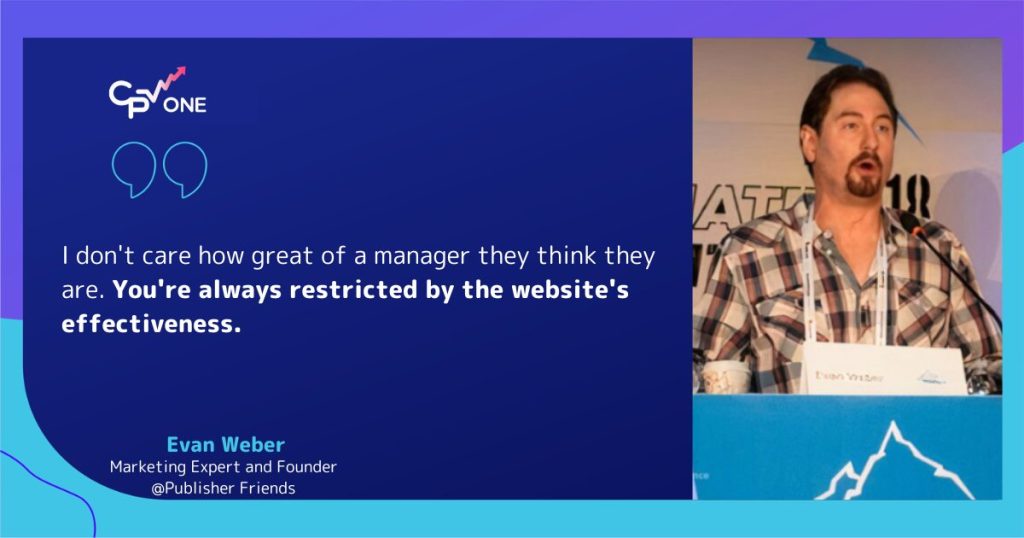
Here’s an uncomfortable truth: most campaigns fail not because of poor ads but because of poor landing pages. The math is simple, if your landing page converts at 1% instead of 2%, you’ve doubled your cost per acquisition regardless of how efficiently you buy media.
Evan Weber, who has optimized landing pages for years, puts it bluntly in our interview about ad strategies:
The key elements to optimize include:
- page speed (if your page takes four to seven seconds to load on mobile, you’re losing visitors before they see your offer),
- mobile optimization (most Meta traffic comes from mobile devices),
- clear CTAs above the fold,
- social proof through reviews and testimonials,
- simplified forms that only ask for essential information.
Quiz funnels have become particularly effective for Meta traffic, especially in health, finance, and self-improvement verticals. By engaging visitors in an interactive experience before presenting the offer, you qualify leads, personalize messaging, and increase psychological investment.
Why Tracking Is Non-Negotiable
Tracking accuracy directly determines optimization quality. Every decision you make, which creatives to scale, which audiences to expand, which landing pages to use, relies on your data. If that data doesn’t reflect reality, every decision built on it will be flawed.
Robert is emphatic about this: “It’s very important. You have no tracking, you have nothing.”
His team focuses on a clear metrics hierarchy: “First of all, we’re looking at the CTR in Facebook, if it’s all right, we continue to move to our CTR on the landing page, and after that, at the end of the day, it’s all about the ROI.”
That progression: ad CTR → landing page CTR → ROI, gives a complete picture of where campaigns succeed or fail.
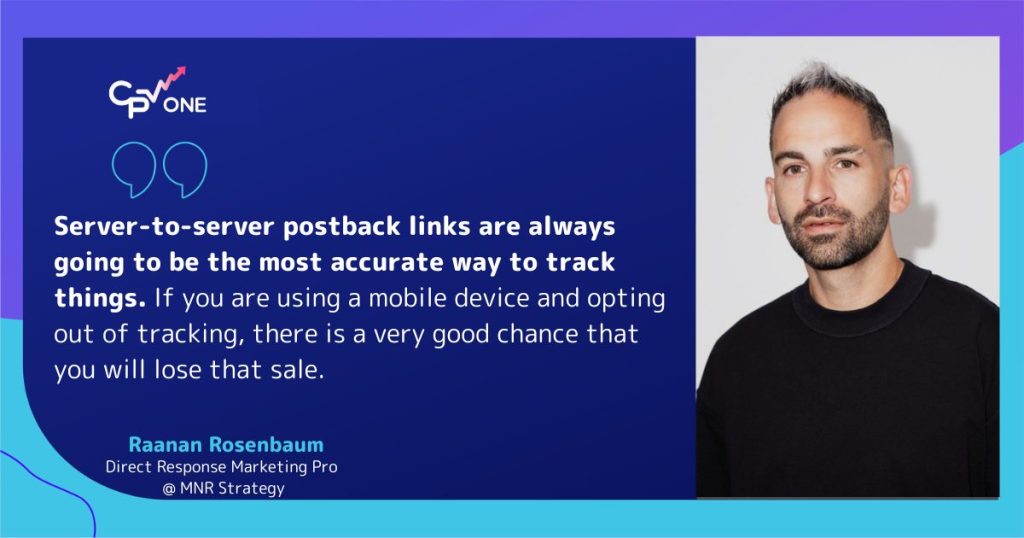
The Meta pixel alone is no longer sufficient. Browser privacy settings, ad blockers, and iOS restrictions all interfere with pixel-based tracking. You need server-side tracking through the Conversions API to get accurate attribution.
Raanan Rosenbaum, who has spent years optimizing tracking systems for performance marketers, emphasizes this point in our interview about ad tracking secrets:
The real risk of inadequate tracking goes beyond just seeing wrong numbers in a dashboard. If you’re running campaigns alongside other affiliates on the same offer and your tracking fails, those conversions might get attributed to someone else. You do the work; they get paid.
How CPV Lab Supports Meta Campaigns
For media buyers serious about accurate attribution, CPV Lab provides the tracking infrastructure that makes data-driven decisions possible when you run Meta Ads campaigns.
CPV Lab performance marketing tracker handles server-side event transmission, sending conversion data to Meta regardless of what’s happening in the user’s browser (S2S).
This ensures your campaigns receive complete optimization signals, critical for that early learning phase where every conversion matters, especially when you’re working toward those first 50 conversions needed to switch to Target ROAS.
By sending multiple signals to Meta, your targeting becomes better and your overall campaign performance is better. CPV Lab can send extra signals, customer data – like email, phone, or name – to Facebook and TikTok via Conversion APIs. This ensures better campaign performance.
When running traffic across multiple platforms like Robert’s team does with Facebook and YouTube, CPV Lab tracks the complete customer journey from first click to final conversion. This multi-source attribution reveals which channels truly drive value versus which are claiming credit for conversions they didn’t generate.
Split testing capabilities let you distribute traffic across landing page variations and let statistical significance guide decisions rather than guesswork. Learn more about pixel vs postback tracking methods to choose the right approach for your campaigns.
Building Effective Remarketing Loops
People who’ve already interacted with your brand are far more likely to convert than cold prospects. Remarketing consistently delivers the highest return on ad spend.
The most effective approach extends beyond Meta alone. Use small daily budgets across multiple platforms, Meta, Google Display, TikTok, dedicated retargeting platforms like Criteo or AdRoll. You don’t need to spend much on each. Even $20 per platform creates an effective remarketing loop where visitors who don’t convert get followed across every platform they use.
Segment your remarketing audiences by intent level. Someone who abandoned checkout deserves different messaging and higher frequency than someone who only viewed your homepage. Set appropriate frequency caps to balance persistence against annoyance.
Getting Started
If you’re new to Meta advertising, here’s a practical starting framework:
- Set up proper tracking first. Implement the Conversions API through CPV Lab or another server-side tracking solution before spending money on ads. You can’t optimize what you can’t measure, and losing those first conversions to tracking issues can cripple your campaign’s learning phase.
- Research before creating. Spend time in the Facebook Ads Library studying what’s working in your vertical. Look at competitor landing pages. Understand the patterns before trying to beat them.
- Start with proven offers. If you’re working with affiliate networks like ClickBank, look for offers that have already been validated with traffic. VSL offers can be particularly good for beginners since the conversion optimization is already done for you.
- Test multiple creatives. Launch with at least 6 ads per ad group, as Robert recommends. Segment by age, images for 50+, videos for younger demographics. Most won’t work, that’s normal. You need volume to find winners.
- Scale methodically. Start with Max Conversions at $50/day, scale to $150, and only switch to Target ROAS after hitting 50 conversions. Give the algorithm the data it needs before asking for returns.
- Prepare for creative fatigue. Build a production pipeline. If you’re scaling aggressively, you might need hundreds of new creatives monthly. AI tools can help with volume, but you still need to test relentlessly.
The Right Mindset
Media buying isn’t gambling, even if it sometimes feels that way.
Andrei puts it well: some people think success is just luck, publish a video, maybe get customers, maybe not. But that’s not how it works. In his view, it’s 97% mindset and 3% technique. If you believe in your product and trust what you’re promoting, you’ll find a way to make it work.
“It’s 97% mindset and 3% technique. If you believe in your product and trust what you’re promoting, you’ll find a way to make it work.”— Andrei, CSWScale
His advice for newcomers is simple: take your time, learn everything you can, and be patient. Success will come. The media buyers who make it are the ones who stick with it long enough for the patterns to emerge.
The Bottom Line
Meta advertising rewards marketers who combine systematic testing with patience and discipline. The fundamentals haven’t changed: accurate tracking provides the data foundation, compelling creative captures attention, optimized landing pages convert that attention into revenue, and consistent testing identifies what works for your specific offers and audiences.
Start with proper tracking infrastructure.
Research before you create.
Test relentlessly, and at scale, that might mean a thousand new videos per month.
Use AI to accelerate production but maintain quality standards.
Scale methodically from Max Conversions to Target ROAS. And give yourself time to learn, the media buyers who succeed are the ones who stick with it long enough for the patterns to emerge.
This article draws on insights from our Champions of Performance Marketing interview series:
Expert Interviews:
- Robert Odaila on scaling sweepstakes with Target ROAS
- Kyle Kostechka: From Accounting to Affiliate Marketing Success Part 1
- Evan Weber: Unlocking Ad Strategies on Affiliate Marketing, TikTok and Modern Brands
- Raanan Rosenbaum: From Jewelry to Performance Marketing Success
- Andrei from CSWScale – Testing strategies, first 5 seconds, and video creation
- Elnur Aliev from Beard Media – VSL offers, testing philosophy, and tracking
Robert Odaila Short Clips:
Watch the full interviews on our YouTube channel and listen on Spotify.

Author: Elizabeta Kuzevska
Elizabeta is a certified Digital marketer with 15+ years of experience and she creates educational content for CPV Lab and CPV One, helping affiliate marketers and media buyers navigate the ever-changing performance marketing landscape. She is also Co-Founder of Revenue Experts AI, building AI Revenue Intelligence Systems powered by 100+ specialized agents. Her methodology integrates multi-agent architectures with human expertise to transform how B2B companies generate revenue.