In this episode of Champions of Performance Marketing, we sit down with Josh Littler, CEO and co-founder of Digital Mojito, a full-service digital marketing agency that runs lead generation campaigns for brands like Maserati, Samsung, North Face, Canada Goose, and Philips. With around 16 years in the industry, Josh works across affiliate marketing, SEO, and performance-based growth strategies.
Throughout the conversation, he keeps coming back to one thing, accurate ad tracking, as the foundation everything else sits on.
In this first part of our conversation, we talk about how Josh got into the industry and built Digital Mojito, what makes a good offer for a media buyer, the traffic sources delivering results right now, how to structure and test a campaign on Meta, what budget you need to get meaningful data, and the mistakes that burn budget early on.
Check the episode on Spotify here:
Or you can watch it on YouTube here!
Q: How did you first get into digital marketing and affiliate marketing?
Josh Littler: It was a long time ago. It was probably about 16 years ago, more or less. Digital marketing was not supposed to be my calling. I think everybody who ends up in this industry had a different vision for their future, but you kind of end up here and you stay. It is quite an addictive space to be in, so you just end up in this industry
I actually started off as a sales guy for an alarm company in Spain. I was getting a bit fed up of going door to door knocking and trying to find clients, so I decided to try my luck.
In Spain, they value that you speak English very highly, over any experience. So I found this digital marketing company in the middle of the Alicante region, and I never looked back since. About 16 years now, I would say.
Q: What led you to build Digital Mojito?
Josh Littler: A number of things, really.
First off, my first job was in lead generation. I was working as the UK country manager for a company. It just so happened that one of my clients at the time offered me a job, and I moved from Spain to the UK.
I was tasked with setting up a brand new arm for their business. They were typically an offline business, and they wanted to start an online business, so I took the knowledge I had at the time and set up the digital side of their business.
Of course, when you work for somebody else, you have to go by their rules and their company policies. There are times where, as a person, you do not necessarily agree, or you would like to make a change or do something and that is not always possible. From there, I moved on to another company, where I was the head of an affiliate network in the UK, managing the network as a whole.
I thought to myself: “I can do this, I know more or less everything that there is to know”. So I am just going to jump in and do it. And that is how Digital Mojito was born. Back in the day, transparency was not really a thing in the affiliate marketing space at the network level.
I led with that, and that decision has brought us to where we are today as a transparency-first agency.
Q: What kind of brands do you work with mostly?
Josh: We specialize in branded campaigns mainly.
We work with brands like Maserati, Samsung, North Face, Canada Goose and Philips. We manage their lead generation campaigns.
They come to us with a specific objective, whether that is to bolster their CRM, generate subscribers, or any objective that would fall under a CPL-based setup.
Then we use our existing affiliate network of partners, which are mainly all direct partners, to deliver those campaigns. So, mainly branded campaigns at this point.
Q: You manage the affiliate programs for these brands?
Josh: Occasionally, but we mainly just do the lead generation more than anything.
Let us take Maserati as a case study. They wanted to generate test drive users to go to the dealership and test drive a car. Our job was to ensure that those users ended up attending the test drive, trying the car, and then having conversations with Maserati about potentially buying the car in the future.
Even though we get paid top of the funnel, we invest a lot of our time and effort into making sure that, further down the funnel, those results translate into sales. So it is a bit of a complex setup.
Q: How do you work as an affiliate network?
Josh Littler: Digital Mojito at its core is an affiliate network. We are not a massive affiliate network, but we do work with large brands, which kind of counts as that.
So we attract a lot of attention with direct affiliates and media buyers, because of the brands we work with. We use Everflow for our base tracking technology, so affiliates know that their tracking is fully on board from end to end on our side as an affiliate network.
Affiliate media buyers use their own tracking solutions like CPV One and CPV Lab to track their campaigns across different channels.
Q: What are the verticals that you see growing, mostly this year?
Josh Littler: That is a tough question, because it is all over the place at the moment, at least in my opinion.
We mainly run campaigns in the EU and the UK. I would say test drives, car test drives, is always a huge vertical for us. We are always generating test drives for different brands.
We also find home improvements, finance, claims, insurance, food, subscription boxes, entertainment and pets.
It really depends. We have a really wide variety. It just depends on the affiliate and their specific interest and niche, but we try to cater to as many as we can. If I was to narrow it down, I do not think I would be able to give you a concise answer, to be honest, because what is working for us is quite a wide variety.
Q: What do you think makes a good offer for a media buyer?
Josh Littler:
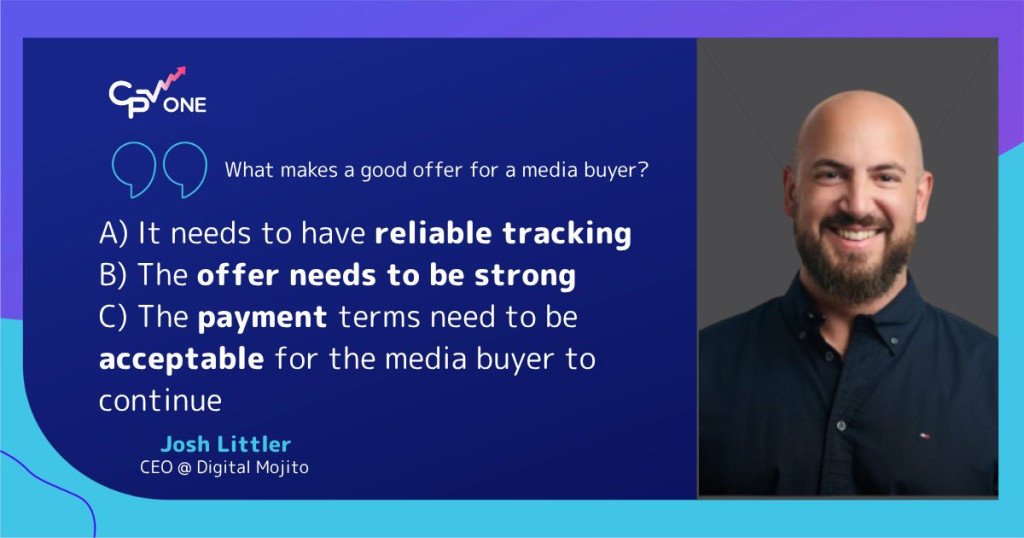
A) it needs to have reliable tracking, in my opinion. A media buyer needs to fully rely on the fact that their campaign will track all of the events necessary for them to optimize their spend and their media buying efforts.
B) the offer needs to be strong. As an agency, we try to get the best offer available for all of our affiliates.Even if there is not a specific offer on their website, or their standard offer is not that strong, we will always suggest a specific angle or an offer that they should at least test, with our interests based completely on our media buyers and affiliates. So the offer needs to be strong and needs to convert well.
Then the offer needs to be strong.
C) And then payment terms need to be acceptable for the media buyer to continue, to receive those funds and reinvest them to scale the campaign.
It is a bit of a juggling act. You have to make sure that none of those balls fall.
But those are probably the three most important things (tracking, offer, payment), at least for a media buyer, and that we then take into consideration for them as well.
Q: How can a media buyer join Digital Mojito to see what offers you have and promote them?
Josh Littler: We would just provide an invite link.
Because our advertisers are a little bit more particular, we have a stricter validation process.
We have a pre-screening interview.
- We find out about the traffic and how you intend to promote the campaigns.
- We stress the fact that we need to share transparency and placements with these brands. That is something we do as an absolute non-negotiable.
So if you are interested in joining us, it is very important that you share those placements with us, so we can see where the ads are being placed and how they are being run and so that at any given time the advertiser can check and see how things are going.
You would probably have a conversation with me, with my co-founder Sonia, or with our affiliate manager Nora. We will onboard you onto the network if you meet all of the criteria.
We do have a strict process, but we are always open to onboarding new affiliates, especially direct affiliates and media buyers who have some experience in this space.
Q: So you focus more on quality affiliates for the brands you promote, focusing on quality over quantity?
Josh Littler: Yes, and we do the same for the affiliate as well.
As I said, we are not a huge network. We have a very limited list of partners and a very limited list of advertisers.
So we try to find an even balance, where we give the affiliates really good quality campaigns with very good payouts and terms, and in exchange we expect the traffic to be at the same level as well. So it is that collaboration.
Q: What traffic sources do you see working best now for your offers?
Josh Littler: For us, and it depends on who is watching this, but strangely enough, email is always king.
Email marketing is always the best channel for us.
I would say quite confidently that 90% of our traffic is email.
We work with direct affiliates, and we sometimes build out our own creatives and landing pages. It is very much geared towards email, but we also find a lot of traffic spiking in native and social, which are the other two channels we focus a lot on.
We do not do a lot in push or pop, just because it is not compatible with the advertisers we work with.
But I would say good placements on Meta, good placements on TikTok, and native platforms is almost a signed deal with the advertisers. And the result is particularly good for the affiliate as well through those channels, if they can crack that CPL target.
Here is another champion talking about Email Marketing, Jonathan Bouchard
Q: For email, you said you run lead generation campaigns. You have to get those emails from somewhere. How does that work?
Josh Littler: Weirdly enough, we do not actually hold any email data ourselves.
We rely completely on our affiliates to deliver our campaigns from an email perspective.
We do have our own sites and our own placements, but it does not justify enough volume for us to monetize that data for other verticals.
So, we would just collect leads for certain specific verticals when the advertiser wants us to do a white label, or trusts our judgment in collecting those leads for them, and then we build our own brand around that.
With email, we rely heavily on our affiliates to deliver through that channel, and then we do media buying on Meta and native internally ourselves.
So, the media buyer is getting the leads from their campaigns. They run a lead generation campaign and then run an email campaign where they send the offer.
It depends on how the affiliate or media buyer wants to work with us. If you have an existing database, great. If you do not, then you can collect your own data through your own efforts via Meta or whatever other channel you want. As long as you use our approved email creatives and subject lines, then you are good to go.
Q: Email seems to be a source that is usually underrated, and then it pops up like that, still very powerful. Why do you think people keep being reminded that email works?
Josh Littler: Yes. You probably find that email is a cost-effective channel as well. If you have the data to send, of course you need the infrastructure in place from a sending platform perspective.
But if you have a reliable provider, the cost to email is almost comparable to none, because you do get decent engagement from it.
Q: Do you see brands preferring a different source of traffic, becoming dependent on one platform, or being flexible? How do you see brands accepting channels?
Josh Littler: It depends on the brand. They are flexible based on their experience with the channel.
If they have had a negative experience, let us say with email, maybe for a lack of compliance or transparency, it is our job as the network to educate them and teach them about our processes.
If we have a secure process and we can provide a case study showing who else is running that channel and finding success, then there is no reason why they should not try it. So it just depends on the brand, but it is a bit of an educational process if they have had a negative experience.
Q: What is your experience with the structure of a campaign for a channel you use most?
Josh Littler: I will start with Meta.
We actually started running Meta not very long ago. Even though we have been in the space for about 10 years, we only started doing Meta more seriously last year. It all came from a conference. We had a conversation that was interesting for us, and we thought, okay, you know what, we can do that; let us try it.
My biggest tip would be not to chase the shiny objects, because I know we can get carried away when we go to conferences and hear all these conversations about what is working for everyone and where they are making hundreds of thousands of euros a month, or even a day, with certain verticals.
So the number one tip is do not get carried away.
Promote something that you know at least a little bit about. I do not know anything about Nutra, so I am not going to promote Nutra. But I do know about automotive, so I am going to set up campaigns based on automotive-related products.
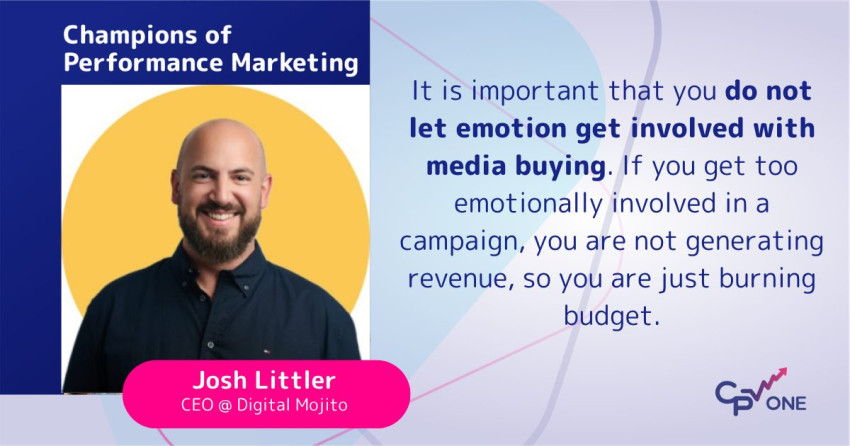
It is important that you do not let emotion get involved with media buying. It does take a lot of time to set up the ads, the creative, and the copy. These days, we have huge help with AI, and we can be a bit lazier with our creativity, but we still need a good base of what we want to promote.
We need a good structure, we need to be organized, and we definitely should not let emotion get in the way.
If you get too emotionally involved in a campaign, it becomes ” no, I need this to work, I need this to work” and you keep seeing that you are not generating revenue from it, so you are just burning budget.
If you think I have spent 24 hours or two weeks on this campaign and I am not getting anything from it, I would strongly advise that you stop it, review it, take a step back, reanalyze it, and see what competitors are doing.
We have got loads of free tools available to us. You do not need to pay for a subscription for anything, simply jump onto the ads library and check what others are doing.
Also, you can search for your specific industry, niche or vertical and do your own research.
You can now filter by most popular or most traffic as well. So there is a lot we can do. And of course, use AI. We have got it there, and most of us are paying for a subscription, so let us use it as much as we can.
To summarize: know your niche, do not get emotionally involved, and control your ad spend to what you can afford to spend.
I think media buyers are side by side with gamblers because we invest money in exchange for maybe getting some money back.
A lot of us are winners; a lot of us are losers. It is just a question of testing, retesting, and trying different angles.
Do not just start with one specific angle and try to see if that works. Try five different angles, with different copy changes and targeting. Keep it broad. Meta has this amazing AI that knows the users better than you do, so use the broad targeting and let Meta do its work. It is in their own interest for you to spend more, and they want to get your campaign delivered, so it is a bit of a balance there.
Q: When you start testing one of your offers on Meta, what do you think is an enough budget to get meaningful data from that test as a minimum budget?
Josh Littler: From our side, because we work with advertisers who pay us on a CPL basis, it is easier to have that CPA target in mind.
If you want to be profitable, you need to set that CPA target a little bit lower than what you are getting paid.
Budget-wise, it depends. I always start with a low budget, or whatever the ad account allows.
If you use your own ad account, sometimes you have to set limits.
I started with a 40-euro-a-day ad spend limit, and I could not spend more than that. As you start spending and scaling, Meta itself automatically updates that limit for you. Then you can get into conversations with them about opening a credit line, maybe working within a 10k or 15k credit for the month. It just depends.
But to start, I would say whatever you are comfortable with spending.
I always aim for two or three times the spend of what I get paid on a cost per lead, more or less. So if I get paid 20 euros, I will aim to spend about 60, somewhere around that figure, per day to start.
Then, after three or four days, once I start seeing the volume come in and the angles that are converting, and once I start seeing the stats, I start switching budgets, trying different angles, incorporating new elements, and increasing the budget on winning angles.
One of the most important things is understanding the data and collecting as much of it as you can about that specific channel and campaign so you can make an educated decision about the next steps and not burn your budget. Data is key for you to make decisions
Q: What mistakes do you see affiliates making that waste the most budget early on?
Josh Littler: The same mistakes that I made, actually.
Panicking when you see that you are not making anything.
You get clicks and no conversions, and you think: “I will change this, I will pause that, I will take the budget away from that”. And in the end you are not letting the algorithm learn. All you are doing is disrupting the process.
For me, the number one thing is to set up something you are confident in and comfortable with, run that, and leave it.
If you want to spend 60 or 100 dollars a day to be conservative and keep things under control and manageable, then set it up confidently, know that the tracking is working, and know that everything is set up as it should be, and leave it. If you start messing around, touching different copies and pausing angles, it just becomes counterproductive.
The biggest mistake I made was panicking and turning things off when I should not have, instead of just leaving it.
Conclusion
In this first part of our interview with Josh Littler, we have looked at how a transparency-first agency approaches branded lead generation, why accurate tracking sits above everything else when judging an offer, and why email still carries the bulk of his traffic alongside Meta, TikTok, and native.
Josh’s core message for media buyers is to know your niche, control your spend, keep emotion out of the decisions, and give the algorithm room to learn before you start switching things around.
In Part 2, we get into creatives, the metrics Josh watches when optimizing, the tracking and attribution gaps that hold advertisers back, and how he uses AI in his daily media buying workflow.
To get the complete picture of Josh’s experience, watch the full video interview on our YouTube channel.
And to get in contact with Josh look for him on Linkedin or simply contact Digital Mojito agency.
Watch the full interview here:
This interview is part of our ongoing Champions of Performance Marketing series featuring marketing experts who share actionable strategies you can implement today. Subscribe to our newsletter to be notified when we release our next expert interview.

Author: Julia Draghici
Julia is the CEO of CPV Lab and CPV One ad trackers. She has 15+ years experience in the software industry, from development to management. For more than 8 years she is helping marketers get the best out of their marketing campaigns by using a performant ad tracker. Passionate about entrepreneurship, business and performance marketing, Julia loves helping people!